 Suomi
Suomi Français
 Deutsch
 Polski
Plan Your Salesforce Rollout
Talk through your Agentforce Marketing goals with Routine Automation. Get consulting, strategy workshops, and technical guidance for a Salesforce setup that fits your business.



Agentforce marketing is exactly the kind of Salesforce phrase that makes people open five tabs and still wonder what they’re actually looking at. Is it a new product? A Marketing Cloud rename? An AI assistant?
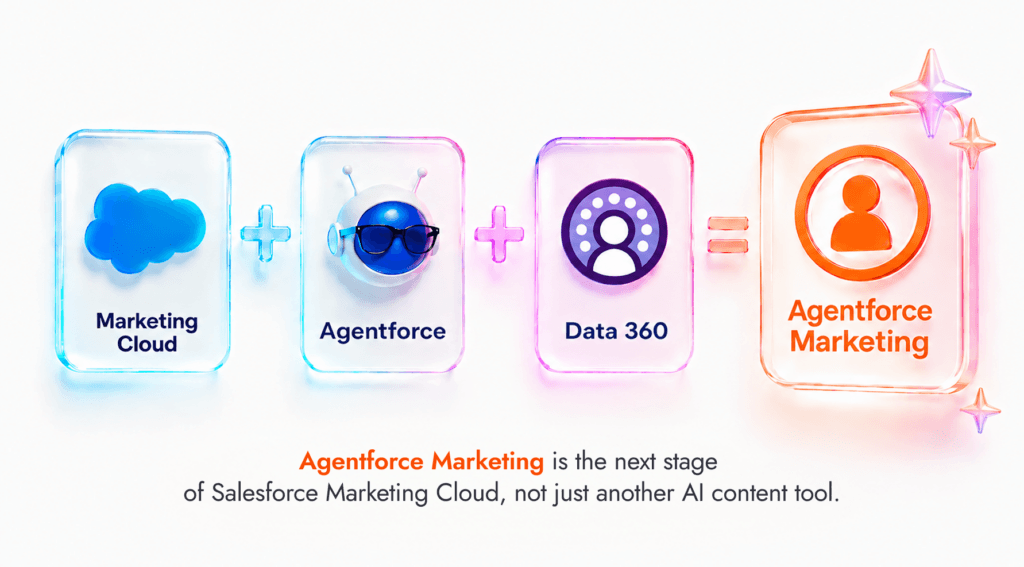
The simple answer is this: Agentforce for marketing is Salesforce’s move toward a more agent-led version of Marketing Cloud. The salesforce marketing cloud Agentforce idea is about bringing campaigns, customer data, content, journeys, replies, and performance work closer to AI agents that can actually do useful marketing tasks.
Really, marketers are already using AI, but plenty of campaign work still feels weirdly manual. Salesforce’s 2026 State of Marketing research found that 75% of marketers have adopted AI, yet 69% still struggle to respond to customers quickly, and 84% admit they still run generic campaigns.
The question is whether Agentforce in marketing cloud can start giving teams the results they’ve actually been looking for. Connected with Salesforce Data 360 and Data Cloud, AI agents can finally use real time context and customer data to support adaptive marketing experiences. That’s worth looking into.
Hopefully, you’re already familiar with Agentforce, Salesforce’s comprehensive solution for agentic AI infrastructure. If not, this “What is Salesforce Agentforce” guide will give you the rundown.
Agentforce marketing is that ecosystem applied to the Marketing Cloud, where marketing automation, customer data, campaign work, and AI agents sit much closer together.
It’s not an “old product out, new product in” situation. Salesforce Agentforce marketing is the next stage of Salesforce Marketing Cloud. Yes, Salesforce now uses Agentforce Marketing as the name for its marketing suite, formerly Marketing Cloud, while Marketing Cloud Next is the newer agentic platform built with AI, Data 360, and Agentforce at the center.
That means the main story isn’t AI-generated content alone. Of course, agents can help draft email copy, SMS messages, campaign briefs, landing pages, and content ideas. Useful, sure. But if that’s all a company does with it, they’ve bought a very expensive writing assistant with better branding.
The bigger value is workflow. Agentforce marketing cloud can help marketers plan campaigns, build audiences, support segmentation, create customer journeys, manage replies, and improve campaign performance when the surrounding Salesforce setup is ready.
This newer direction can include Marketing Cloud Next, Data 360 / Data Cloud, Agentforce, AI agents, campaign generation, customer data activation, and more conversational customer engagement. So you get a complete agentic marketing solution built on Salesforce’s core platform, designed for personalization and two-way conversations across the customer relationship.
Make Agentforce Useful
Turn Agentforce from a Salesforce idea into practical marketing workflows with clear use cases, clean data, safe actions, and controlled rollout.
Salesforce Marketing Cloud is still where a lot of teams run the hard campaign work: email, SMS, journeys, segmentation, personalization, automations, reporting, all of it. Agentforce for Marketing Cloud sits over that work as the newer agent layer, helping marketers move from “build every step yourself” to “give the system a goal, then review what it creates.”
It’s similar to how Agentforce for Sales combines agentic AI with the sales processes teams already use in Sales Cloud, just shaped for marketing instead.
Area | Classic Marketing Cloud work | Agentforce Marketing direction |
Campaign setup | Marketers build the audience, journey, content, tests, and reports step by step | Agents can help turn a campaign goal into a brief, audience, journey, and draft assets |
Customer data | Teams rely on CRM syncs, lists, data extensions, and configured fields | Data 360 can give agents a fuller customer view across marketing, sales, service, and commerce |
Personalization | Rules, segments, templates, and journey branches do most of the work | Agents can use more customer context to suggest timing, content, offers, and next actions |
Customer replies | Campaigns push people toward forms, inboxes, or support queues | Email, SMS, and web can become two-way conversations with agent support |
Campaign improvement | Reporting usually happens after the campaign has run | Agents can read performance signals and suggest what to change while the campaign is still alive |
Team workload | Marketing ops carries a lot of manual setup | Marketers set the goal, review the output, and control what the agent can do |
Marketing Cloud Next is where this shift becomes deeper. Salesforce brings Agentforce, Data 360, Flow, content, journeys, and campaign improvement into the same working model, so marketers can create and adjust campaigns with more context behind them.
For most companies, the best move will be small at first. Pick one piece of campaign work that already wastes time. Webinar follow-up. Segment creation. Re-engagement campaigns. Weekly performance summaries. Let Agentforce 3.0 support that workflow, test it hard, and then widen the use case once the team trusts the behavior.
Agentforce marketing cloud works through AI agents that are given a specific marketing job inside Salesforce. That job might be drafting a campaign brief, building a first-pass audience, checking performance after a send, replying to a simple customer question, or preparing a follow-up plan for sales.
It starts with the marketer, which is how it should be. They set the goal, the task, the rules, and the approved actions. Agentforce uses Salesforce data, prompts, topics, and actions to carry out the work, with Data 360 or Data Cloud adding customer context from sales, service, commerce, and marketing.
Take webinar follow-up. Someone asked about pricing, then disappeared before booking a meeting. An Agentforce for Marketing Cloud agent could build the audience, draft the email and SMS, write the sales note, and point out who looks most engaged. The marketer still reviews the segment, copy, and next step.
The catch is setup. Agents need clean data, clear prompts, approved actions, and guardrails. Without those, they don’t save marketing ops from busywork. That’s why so many companies look into Salesforce Marketing Cloud Services, before adding AI.
Salesforce Agentforce for marketing helps with the work marketers complain about in private: getting campaigns out the door without breaking audience logic, annoying legal, missing sales context, or spending three hours chasing a report nobody trusts.
The useful use cases sit in the gaps between teams. Marketing has the campaign idea. Sales has the account context. Service has the complaint history. Commerce has the purchase signal. Agentforce only becomes interesting when those signals start feeding the same workflow.
A campaign almost never falls behind because one person is stuck on copy. It falls behind because the audience logic is messy, approvals drag, the SMS version gets missed, QA catches something ugly, and reporting gets treated like an afterthought.
Agentforce marketing can help create the first working version: campaign drafts, suggested flows, content ideas, email copy, SMS copy, and next-step recommendations. Salesforce’s Help page says Agentforce in Marketing Cloud Next can help draft, refine, and generate multichannel and conversational campaigns, then analyze campaign performance after launch.
I wouldn’t let it publish without review. I would absolutely let it get the team from blank page to something worth arguing over.
Plenty of teams still build segments from campaign behavior alone: opened, clicked, downloaded, attended. That’s fine for simple campaigns. It’s thin for anything more serious.
Agentforce can help shape audiences from customer data, behavior, lifecycle stage, engagement history, sales activity, service interactions, and commerce records. Data Cloud helps by bringing those signals into a more complete customer profile, so the agent isn’t treating an email click as the whole story.
Static journeys are easy to build and easy to outgrow. A customer who opens a pricing email, visits the upgrade page, and then logs a complaint shouldn’t keep getting the same nurture message as someone browsing casually on a Sunday night.
Agentforce marketing helps journeys become more responsive to customer context and real-time behavior. The agent can suggest a different message, a different wait step, a different channel, or a human handoff based on what the customer is doing now.
“No-reply marketing” has always been a little absurd. Brands beg people to engage, then send from an inbox that basically says, “Actually, don’t talk back.”
Agentforce gives Salesforce teams a way out of that habit. AI agents can manage simple replies, answer basic questions, keep a conversation going, or route the messy stuff to the right team.
A customer replies to an event SMS asking whether the session is recorded. The agent answers. Another asks about pricing. Sales gets the handoff. Someone complains about an order. Service gets pulled in. That’s a much healthier loop than dumping every reply into a shared inbox nobody checks.
Agentforce for marketing can also support web recommendations, product suggestions, content prompts, and guided customer interactions when the right Salesforce data is available.
Picture a visitor from a target account coming back to your site. They’ve attended a webinar, read two comparison pages, and already spoken to sales. Showing them beginner content wastes everything you know about them. With better customer context, an agent can point them toward the next useful product, event, offer, or sales step.
For B2B teams, this is probably the most practical early use case. Leads cool off quickly. A form fill waits too long, a webinar attendee gets ignored, and a good account visits the demo page while everyone finds out days later in a report.
Agentforce for Marketing Cloud can help with webinar follow-ups, lead qualification, account engagement, and sales handoff prep. It can summarize what the person did, suggest the right nurture path, and give sales a cleaner reason to follow up.
Agentforce helps when the marketing team has too many campaigns and too few hands.
Not in a “replace people” way. More in a “please stop making skilled marketers spend half the day stitching together first drafts and performance notes” way.
A good agent can help with campaign assets, segment updates, performance checks, follow-ups, and reporting notes. That might sound small until you’re the team running email, SMS, webinars, site updates, paid campaigns, and Monday’s numbers.
Campaign reporting is where the optimism can break down.
Agentforce Marketing should be tied to performance, attribution, and campaign improvement from the start. Salesforce announced Agentforce Paid Media Optimization for Marketing Cloud Next, with the ability to monitor performance and help shift spend away from weaker ads toward higher-value audiences.
That’s the better promise here. Less guesswork. Better signals. Faster correction when a campaign is going nowhere.
Automate Smarter Campaigns
Build Agentforce workflows that cut campaign admin, improve personalization, and keep managers in control of data, approvals, and customer replies.
It’s easy to see how Agentforce transforms marketing strategies when you dive into it.
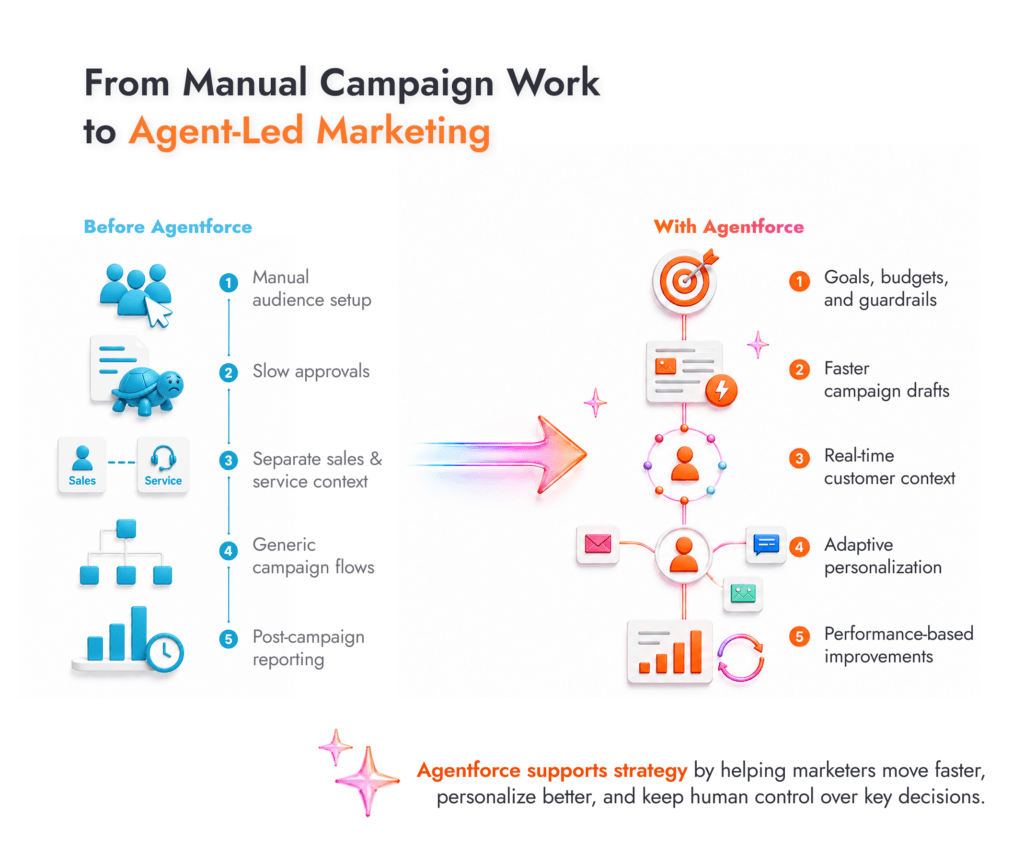
With Agentforce, Salesforce Marketing Cloud moves teams away from building every campaign step by hand and toward a model where marketers set the goal, the limits, and the review process.
Salesforce’s newer Agentforce Marketing Goals Agent is a good example of where this is heading. Salesforce says marketers can define goals, budgets, guardrails, and autonomy limits, then agents create, run, and improve campaigns inside those boundaries, using customer context and live signals to choose content, channel, audience, and timing.
That changes the marketer’s job in a few real ways.
First, repetitive setup takes up less space. Audience drafts, campaign briefs, journey ideas, first-pass email copy, SMS variants, and performance summaries can be prepared faster. Someone still needs to check the work, but the team isn’t starting from nothing every time.
Campaigns can move faster too. A slow campaign usually dies in the handoffs: copy, audience, approvals, QA, reporting, sales notes. Agentforce can pull more of that work into one flow, which means fewer loose ends sitting in someone’s inbox.
Personalization also gets less clunky. Instead of building broad segments and hoping they’re good enough, teams can use customer behavior, lifecycle stage, sales activity, service cases, and commerce data to shape the next message. Salesforce says Agentforce Marketing can generate real-time segments, adapt experiences to individuals, and deliver answers across channels.
Then there’s the sales and service connection.
Marketing has spent years pretending a customer’s inbox behavior tells the whole story. It doesn’t. If a customer just opened a support case, missed a renewal call, or asked sales about pricing, marketing should know before sending the next cheerful promo.
Agentforce marketing is much better at supporting a strategy than creating one from scratch. It needs clear audiences, trusted data, sensible journeys, and a firm line around human review.
Before using Agentforce in marketing cloud, check the system around it.
Agentforce depends on the quality of the Salesforce and Marketing Cloud setup it’s working inside. If the data is messy, the journeys are old, and nobody agrees what a “qualified lead” means, the agent inherits all of that. You need to think about:

Customer data quality: Start with the customer data. Duplicate records, outdated fields, broken account relationships, missing consent data, and disconnected systems will all weaken personalization.
Marketing Cloud setup: Next, look at the current Marketing Cloud build. Review active journeys, old automations, segmentation rules, email and SMS processes, campaign workflows, suppression logic, consent handling, reporting tags, and connected systems. Salesforce consulting services can help a lot here.
Data 360 / Data Cloud readiness: Which data sources should the agent use? Which fields matter? Who owns them? How fresh are they? Which records should never be used for customer-facing decisions?
Agent actions and guardrails: Actions are what the agent is allowed to do. Guardrails are the hard stops. A marketing agent might draft an email, suggest a segment, summarize results, or prepare a follow-up task. It shouldn’t touch consent records, promise discounts, answer legal questions, or send sensitive replies without approval.
Testing and monitoring: Test the agent before it goes live. Then keep watching it after launch.Try normal prompts. Try awkward prompts. Try vague prompts. Test customer replies, handoffs, permissions, Flow actions, and record updates. Salesforce’s Trailhead materials warn that agent testing may use requests and credits, and some actions may change CRM data, so sandbox testing is the safer route before live use.
AI always has limitations, regardless of whether you’re using Agentforce for field service, or relying on it to help with your marketing campaigns.
AI output still needs a human eye. Campaign copy can sound fine and still miss the offer. A segment can look sensible and still include the wrong lifecycle stage.
Poor data is the next obvious trap. If sales activity, service history, consent records, and commerce data aren’t connected or cleaned, Agentforce makes decisions from a partial view. That’s how a customer with an open complaint ends up getting a cheerful upsell email.
Sensitive conversations need a harder line. Agents can handle simple replies, event questions, basic product details, and routing. Refunds, complaints, pricing exceptions, contract questions, legal issues, and anything regulated should move to a person. No debate there.
Setup is another real limitation. Agent actions, Flow logic, permissions, data access, brand rules, and Marketing Cloud journey behavior all need someone who understands Salesforce properly, which is often where the best Salesforce consulting companies come in.
Limitation | What usually goes wrong | How to control it |
AI output needs review | The message sounds polished, but the offer, tone, or audience is wrong | Require approval for copy, segments, sends, and customer replies |
Poor data weakens decisions | Duplicate records or missing fields lead to odd personalization | Clean the core customer data before scaling use cases |
Some replies are too sensitive | Complaints, refunds, legal questions, and pricing exceptions get mishandled | Set strict escalation rules by topic and risk |
Setup needs Salesforce knowledge | Actions, permissions, journeys, and flows get connected too loosely | Use Salesforce and Marketing Cloud experts for configuration |
Ownership gets fuzzy | Marketing, RevOps, admins, sales, service, and legal all assume someone else is checking it | Name owners for prompts, approvals, QA, reporting, and compliance |
Old Marketing Cloud builds drag it down | Legacy journeys and old automations confuse the agent’s work | Audit and clean the environment first |
Testing can affect real data | Agent tests or actions may update CRM records if run carelessly | Test in a sandbox and monitor behavior after launch |

Routine Automation doesn’t just offer Salesforce implementation services. They can help businesses work out whether their Agentforce for Marketing Salesforce setup is actually ready for launch, or scale.
Routine Automation can review the current setup, map the weak spots, and help teams choose practical Agentforce use cases instead of chasing “AI for everything.” That phrase usually means nobody has picked a real business problem yet.
Support can include:

Salesforce Marketing Cloud audits
Salesforce data and connected-system reviews
marketing automation cleanup
Agentforce use case planning
AI readiness checks
Agentforce setup support
testing before launch
ongoing tuning after the agent starts working
Routine Automation can also help design the agents themselves. That means deciding what each Agentforce marketing agent should do, which Salesforce data it should use, which actions it can take, when it needs to hand work to a person, and which guardrails keep it safe.
A proper setup might include agent topics, actions, permissions, Salesforce and Marketing Cloud data connections, test scenarios, prompt edits, workflow checks, and ongoing review. It’s fiddly work, but it’s what stops the agent becoming another thing marketing ops has to babysit.
Set Up Marketing Agents
Configure Agentforce agents with the right data, actions, permissions, testing, and guardrails, so your team can automate campaign work without losing control.
Agentforce Marketing is bigger than an AI feature tucked into the corner of Marketing Cloud. It’s Salesforce moving toward a more agentic version of marketing, where AI agents help teams create campaigns, personalize journeys, respond to customers, and improve performance without rebuilding every step by hand.
The teams that get the best results won’t be the ones that switch on agents fastest. They’ll be the ones that do the dull prep properly. Clean customer data. Sensible Marketing Cloud processes. Data 360 / Data Cloud readiness. Clear human review. Practical goals that a team can actually test.
Companies exploring Agentforce Marketing should start by reviewing whether their Salesforce and Marketing Cloud setup is ready for controlled agent work. If the wider rollout needs custom planning, Routine Automation’s services can help connect the strategy, system setup, and day-to-day marketing process.
If you’re already seeing those cracks, it’s probably worth talking through the setup.
Agentforce Marketing is Salesforce’s move toward marketing run with AI agents, not only fixed automation rules. It connects campaign work, customer data, journeys, content, and engagement tasks inside the Salesforce platform, so marketers can create and adjust campaigns with more context behind each action.
Salesforce now uses Agentforce Marketing as the wider marketing suite name, formerly Marketing Cloud. Marketing Cloud Next is the more agentic platform inside that direction. For existing Salesforce teams, it’s better to see this as a shift in how Marketing Cloud work happens, not a clean replacement.
Agentforce works through agents with assigned tasks, approved actions, data access, and guardrails. In Marketing Cloud, an agent might draft a campaign, suggest an audience, prepare content, check results, or route a customer reply. The team still sets the rules and approves sensitive work.
Agentforce for marketing salesforce use cases include campaign drafts, audience building, journey changes, lead follow-up, reply handling, website recommendations, reporting, and campaign fixes. The best first project is usually narrow: one slow workflow, one clear goal, clean data, and a review process people will actually follow.
Yes. Agentforce Marketing can support email and SMS drafts, campaign flows, reply handling, follow-ups, and routing. The more interesting part is the reply loop. A customer can ask a simple question, get an answer, or move to sales, service, or another team when the issue needs a person.