 Suomi
Suomi Français
 Deutsch
 Polski
Talk Through Your Agentforce Automotive Setup
Bring us one dealer, sales, or service workflow. We can workshop the approach, check the data and system connections, and map the Salesforce work needed before you build.



At 11:17pm, someone, somewhere, will still be shopping for a car. They’ve maybe found an EV they like, checked the trim, played with the payment calculator twice, and now they want one fairly boring answer: is that exact vehicle actually available?
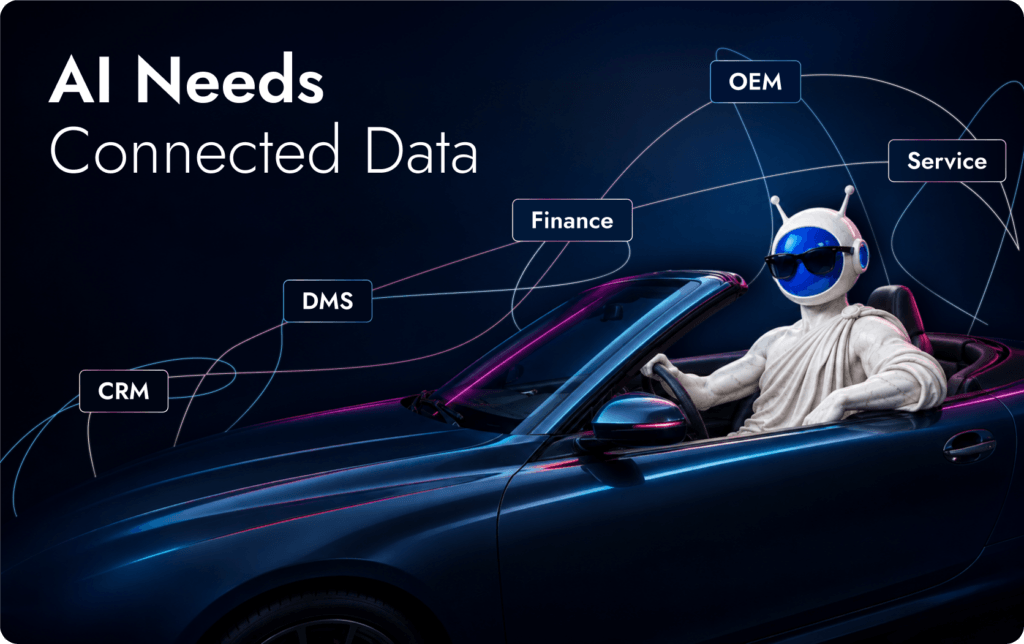
That question is a decent test for AI for car dealerships. The automotive CRM may know who the buyer is. The DMS has the VIN. The current incentive came from the OEM. A solution like Agentforce for automotive can keep the conversation moving, assuming those records actually agree. That agreement is the important part.
There’s a lot of enthusiasm around Agentforce right now, but dealers are still figuring out how much of it they can trust with real work. Cox Automotive found 63% see AI investment as critical to long-term success, while fewer than 15% said they’d actually embedded AI into workflows and decision-making. That’s worth thinking about before you go all-in on Agentforce.
A dealer can have a perfectly good DMS, Salesforce CRM implementation, finance platform, and OEM portal and still make a customer repeat the same story three times.
Each system may be doing its own job properly. The problem appears in the spaces between them. A vehicle shows as available on one screen and reserved on another. An OEM changes an incentive before the dealer’s data catches up. Sales knows what the buyer asked for last week, while the service advisor can only see what happened in the workshop.
Warranty work can be worse. A fairly ordinary claim may bounce between an OEM portal, an attachment, a spreadsheet, and somebody’s inbox before anyone knows what’s happening.
Lead handling has the same problem, except the clock is running. Older lead-response research found that contacting a web lead within five minutes rather than waiting 30 minutes made qualification 21 times more likely. It wasn’t automotive research, and the study dates back to 2007, so I wouldn’t pretend it’s a modern dealer benchmark. It does explain why leaving an interested buyer until Monday morning is risky.
We’ve got better automotive evidence now, too. Pied Piper tested 3,290 dealer websites in 2026. When automated responses needed a person to step in, customers were twice as likely to receive no personal response. The systems had done something. The customer still got stranded.
That’s where dealership automation earns or loses its value, far before you start worrying about Agentforce Automotive. It’s better to fix the inventory mismatch and the broken handoff before adding another chat window that answers the wrong question faster.
Fix the Gaps Before Adding AI
Don’t buy Salesforce on reputation alone. See what you’d get from CRMs that are cheaper, easier to pick up, or a better fit for the way your team works.
Fixed ops has always been the bit of the dealership business people come back to when car sales get shaky. You sell a vehicle once. If things go well, you keep seeing the owner for oil changes, filters, brakes, scheduled maintenance, and whatever starts making an expensive noise three years later.
EVs change the math a bit. The IEA says more than 20 million electric cars were sold in 2025, roughly one in four new cars worldwide, and that share’s expected to rise again in 2026. For dealers, that means less routine mechanical work to count on. No oil changes. Fewer drivetrain parts wearing out. Service intervals look different too.
That doesn’t mean the death of aftersales is on the horizon, though. Cox Automotive says average dealership service and parts revenue reached about $9.23 million per store in 2025, 33% higher than in 2018. At the same time, dealers’ share of service visits slipped from 33% to 29%.
That combination is more interesting than the usual “EVs need fewer oil changes” argument. There’s still plenty of money in service. Dealers just have less room to assume the customer will keep coming back. Battery condition, tires, software, charging faults, connected features and remote diagnostics all create different reasons to start a service conversation.
This introduces a new opportunity for Salesforce Agentforce implementation in the automotive space. If a vehicle produces a genuine service signal, AI agents for automotive teams can help you act on that rather than waiting six months and sending another generic maintenance email. As the old maintenance rhythm changes, spotting the right moment to contact someone becomes part of the revenue model itself.
We’ve answered the question “What is Salesforce Agentforce?” broadly in a previous article, but it’s worth making the response more relevant to automotive teams.
Agentforce hasn’t made the naming especially friendly. Salesforce Automotive Cloud is now being branded Agentforce Automotive, while “Agentforce for Automotive” still appears across Salesforce pages when it talks about the agents themselves. Data Cloud has also been renamed Data 360.
What matters is what Agentforce in an Automotive CRM can actually do. In Salesforce, Agentforce gives an AI agent (or multiple) access to approved Salesforce context and a limited set of things it’s allowed to do with that context. A service request comes in. The agent can read the customer and vehicle record, work out what kind of request it is, call an approved action, then pass the awkward cases to somebody who gets paid to make judgment calls.
That’s quite different from the little chat box dealerships have had on their websites for years. Those bots usually recognize a question and follow a path somebody built beforehand. An AI agent automotive setup has more freedom to work out which approved route fits the situation.
The useful part isn’t that the agent sounds clever. It’s that it can work with the same customer, vehicle, service and dealer information the rest of Salesforce uses, then connect that information to an actual process.
The data underneath has to be right first. Salesforce’s automotive setup uses its industry data model and Data 360 to pull customer and vehicle context together, with outside systems connected separately. If inventory is stale or two systems disagree about the customer, Agentforce for Automotive doesn’t somehow sort that mess out through intelligence. It starts from the mess.
A reliable Salesforce Flow can still handle a fixed calculation, approval, or record update. I’d leave those jobs alone when they already work. Give the agent the fuzzy bit at the front, where somebody has asked a messy question or several possible routes make sense, and keep predictable work predictable.
Build One Agent You Can Trust
Start with one useful workflow, the right data behind it, and clear limits on what Agentforce is allowed to change.
I wouldn’t start by asking where Agentforce could be used. You could probably force an agent into half the dealership if you really wanted to. Start with the irritating jobs people already lose time to. The ones where the next step is fairly obvious, but the information needed to take it is spread across too many places.
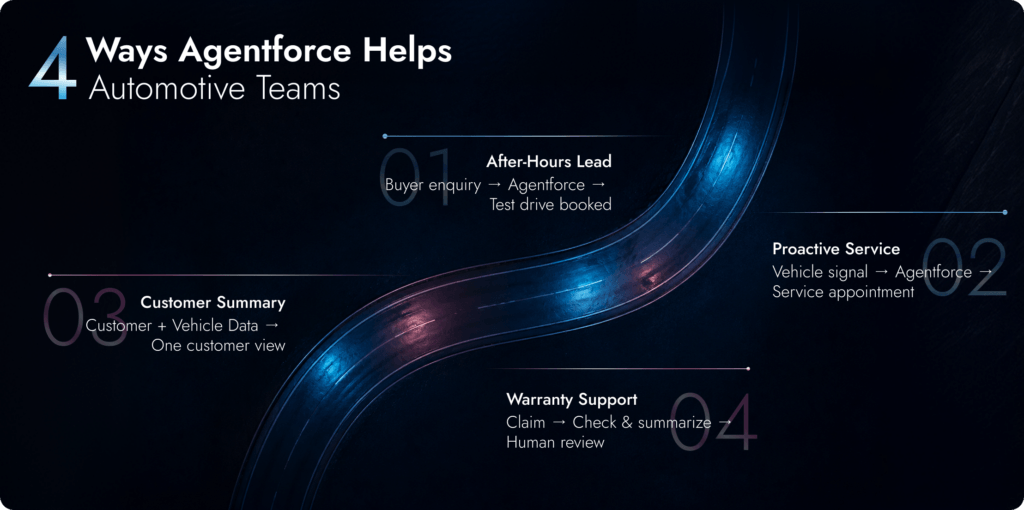
A buyer messages at 11:40 p.m. asking whether a particular SUV is still available and if there’s a test-drive slot on Saturday.
That’s a reasonable job for an agent, provided the stock data is current. Salesforce’s Automotive Sales Concierge can search vehicles and dealers, create opportunities and quotes, schedule test drives, and start a trade-in appraisal. It’s a very useful extension of Agentforce for Sales.
The catch is almost painfully mundane: Salesforce warns that bad seller-product status data can produce bad search results. So yes, the agent might answer at midnight. If it offers a car that left the lot yesterday, nobody is going to be impressed by the response time.
An EV reports a battery-health issue. Nobody has to wait for the owner to remember they meant to call the dealership three weeks ago.
Salesforce’s proactive-maintenance agent in Agentforce Automotive can work with telemetry, vehicle records, warranty information, products, quotes, and work orders. It can summarize what’s happening, prepare work, and draft the outreach. Appointment scheduling sits alongside that process through Salesforce Scheduler.
This is one of the more convincing uses for AI agents for automotive teams. There’s an actual event behind the contact. The dealership has something useful to say, at a moment when the customer has a reason to listen.
Service advisors already do a surprising amount of detective work.
A customer turns up and says, “It’s doing that thing again.” Now someone has to work out what “that thing” was, whether it was discussed on the last visit, whether there’s an open case, what the warranty says, and whether sales promised anything useful or unfortunate along the way.
Salesforce’s Customer Summary use case can bring the relevant customer and vehicle information together before that conversation gets very far. The key is making sure you’ve got the records underneath the AI aligned first, which is generally where Salesforce implementation partners come in.
Some warranty work is basically professional waiting around. Someone checks the vehicle. Then the part. Then the claim. Then the coverage. Something is missing, so an email goes out and the case sits there until somebody remembers to look again.
In the Agentforce for Automotive kit, Salesforce’s Warranty Claims Assistance agent can summarize submitted claims, check status, and validate warranty coverage for vehicles, assets, and parts. Its automotive service agents can also handle routine payment-deferral and due-date requests, including eligibility checks and case creation.
That’s a sensible place for AI for dealerships. Let the agent chase the predictable facts and get the request into shape. Don’t give it the final say on a disputed claim, a strange goodwill repair, or a financial exception. Those are the moments where somebody needs to own the decision rather than point at whatever the system produced.
Stop Automating the Wrong Work
Pick one sales or service process that’s eating time now. We’ll map the data, approvals, actions, and handoffs needed to make Agentforce useful when the workflow gets messy.
Agentforce Automotive isn’t a way to work around a messy Salesforce setup. If the same customer exists three times across the DMS, CRM, and marketing platform, the agent has three versions of the truth to choose from. Giving it more autonomy doesn’t fix that.
Salesforce’s own 2026 data research is pretty sobering here. Data leaders estimate that 26% of organizational data is untrustworthy, and 89% of companies with AI already in production said they’d seen inaccurate or misleading AI output.
There are limits I wouldn’t try to automate away either. Using Agentforce for marketing, or to manage a routine appointment is one thing. An unusual pricing exception, disputed goodwill repair, recall conversation, finance decision, or angry customer threatening legal action needs somebody who can own the answer.
A useful way to set the boundaries is to decide how far the agent is allowed to go before you build it:
Authority | Automotive example | Where to start |
|---|---|---|
Observe | Spot a stalled lead or service trigger | Low risk |
Advise | Suggest the next service action | Person checks it |
Prepare | Build a quote, claim, appraisal, or refund request | Person approves |
Act | Book a routine appointment inside fixed rules | Only after testing |
Human only | Safety, legal, unusual pricing, finance, disputed goodwill | Keep explicit ownership |
Then there’s the plumbing again. DMS platforms, OEM systems, telematics feeds, finance systems, and Salesforce don’t magically agree because Agentforce has been switched on. Someone still has to map fields, decide which system wins when values conflict, handle API failures, and work out what happens when a sync arrives late.
Be especially wary of rolling an agent across 30 rooftops at once. One store with one messy workflow will teach you more than a giant launch deck ever will.
Using AI for automotive industry growth is exciting, but it’s not something you should rush. Pick something you can measure before Agentforce touches it.
“Make us more agentic” is useless as a project goal. “Cut median lead response from 42 minutes to 10” gives you something to argue with later. So does improving first-service booking, shortening warranty processing time, or cutting the time an advisor spends digging for customer history.
Before building anything, write down exactly what that workflow depends on. For an after-hours lead, that could mean customer identity, live inventory, dealer location, incentives, appointment slots, and contact consent. For proactive service, you’re looking at the vehicle, telemetry, warranty cover, service history, parts, and workshop capacity.
Working with a consultant like Routine Automation that excels in preparing your CRM and AI for dealerships helps a lot. If nobody can answer “Which system owns this field?” without starting a meeting, don’t give an agent permission to act on it yet.
Question | Strong answer | Warning sign |
|---|---|---|
What changes if this works? | A named business KPI | “Better AI adoption” |
What data does it need? | Named systems and fields | “Everything in Salesforce” |
Which source wins a conflict? | One agreed system of record | Whichever updated last |
What can the agent change? | Specific approved actions | Broad record access |
When does a person take over? | Defined trigger and queue | “When necessary” |
Bring the sales floor and service desk into those tests early, too. Cox found 74% of dealers were worried about AI accuracy and errors, while 66% wanted more AI education and training.
Routine Automation has already worked on the awkward automotive bits that tend to decide whether an AI project survives contact with real operations. With Profil, the team connected Salesforce Field Service with SAP and helped bring scattered service work into one place. For a European mobility manufacturer, it built REST connections between Salesforce, ERP, and local dealer systems, covering stock, reservations, maintenance alerts, and contract data.
That experience matters. As a Certified Salesforce partner, RA works across Automotive Cloud, Sales and Service Cloud, and the DMS, ERP, and other connections sitting behind them. It also offers dedicated Salesforce Agentforce implementation support.
If the first half of this article sounds familiar, that’s really the point. Agentforce gets much easier to trust once the customer, vehicle, dealer, and service records underneath it stop disagreeing.
No. Use Agentforce Automotive to take repetitive work off people’s plates: pulling customer history, checking routine eligibility, preparing records, or booking straightforward appointments. Salespeople, service advisors, and managers still need to handle negotiation, unusual complaints, safety issues, finance exceptions, and anything where a customer deserves a human answer.
Most dealership chatbots answer common questions or follow a scripted route. Agentforce AI agents for automotive teams can use Salesforce customer and vehicle data, then call approved actions inside a workflow. Depending on the setup, that could mean finding inventory, creating an opportunity, scheduling a test drive, or handing the conversation to a rep with the history attached.
Start with clean customer and vehicle records, clear systems of record, and working connections to the DMS, inventory, service, or telematics platforms the agent will depend on. You also need defined permissions, a human handoff route, one measurable use case, and someone responsible for checking what the agent does after launch.
In most cases, you can keep the DMS you already use. Agentforce Automotive works through Salesforce, so the real job is getting the right dealer data into Salesforce and keeping it current. That usually means APIs, MuleSoft, or custom connections for things like inventory, customer records, service history, and appointments. The tricky part is deciding which system wins when the DMS and Salesforce disagree.
There isn’t a sensible universal timeline. An internal agent using clean Salesforce data can be tested fairly quickly. A customer-facing process that depends on several rooftops, DMS connections, live inventory, or telematics will take longer because the data and testing work becomes the real project. I’d judge the pilot by the KPI, not the calendar.