 Suomi
Suomi Français
 Deutsch
 Polski
Minimize Costs to Fit Your Budget
Discuss your requirements, architecture and implementation options with a team that can connect Salesforce investment to real business processes.



There’s no useful one-line answer to how much does Salesforce cost. A small sales team could start with Salesforce pricing at $25 per user/month for Starter, while Sales Cloud Enterprise, Unlimited, and Agentforce 1 Sales currently list at $195, $395, and $550 per user/month. Those higher tiers are generally sold on annual contracts.
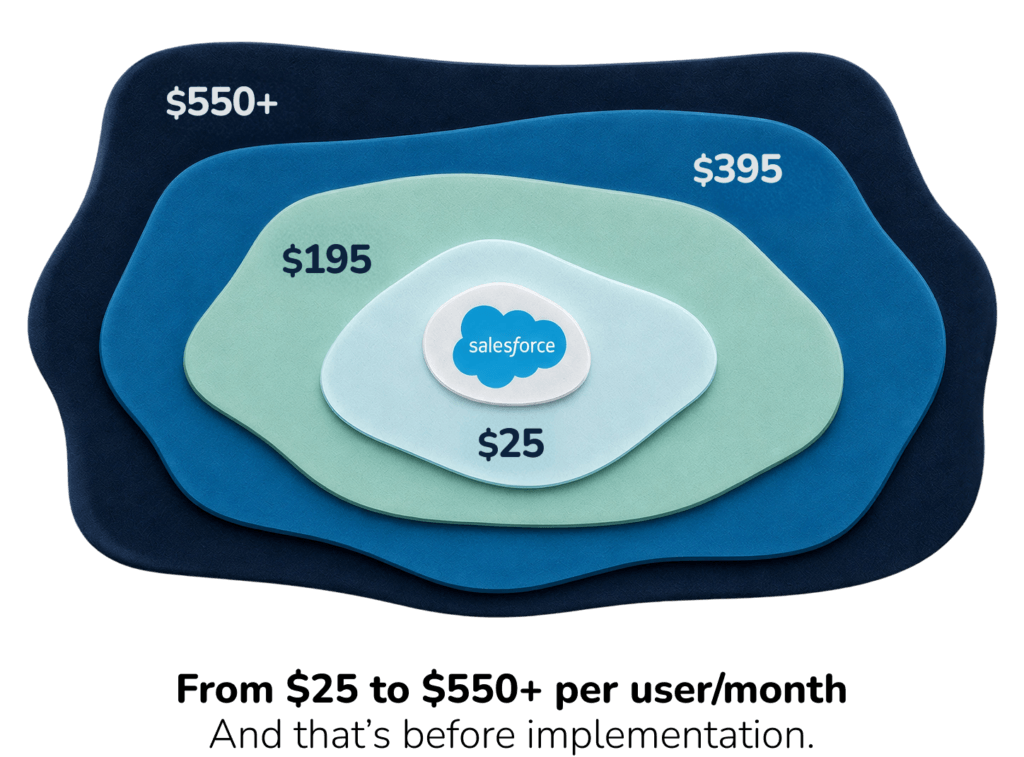
That’s quite a spread before anyone migrates a record. The Salesforce cost for a 12-person sales team won’t even resemble the budget for a multi-department enterprise connecting ERP, finance, ecommerce, marketing, support, and customer data. This guide covers the latest ranges from September, 2026, and sticks to US pricing, checked against Salesforce’s own pages, then gets into the costs that arrive after the license quote.
Salesforce pricing gets confusing for one reason: the unit changes depending on what you buy. Sales Cloud is usually priced by the user. Marketing Cloud Next can be priced for the whole org. Agentforce can meter actions, conversations, or successful resolutions. Commerce can tie cost to GMV. Then a few products simply send you to Sales for a quote.
A sales rep using Salesforce all day, a field worker checking jobs occasionally, a partner logging into a portal, and a customer using self-service a few times a year shouldn’t automatically sit on the same type of licence.
Pricing model | What Salesforce is charging for | Current example |
|---|---|---|
Per user | A named employee with regular access | Sales Cloud Starter Suite: $25/user/month |
Per member or login | External users who need ongoing or occasional access | Partner Cloud ($25 per member per month) |
Per organization | One product subscription for the Salesforce org | Marketing Cloud Next Growth: $1,500/org/month |
Consumption | Actions or processing used | Agentforce Flex Credits: $500 per 100,000 credits |
Per conversation | A customer-facing AI interaction | Agentforce Conversations: $2/conversation |
Per resolution | An AI support issue resolved successfully | Help Agent: $2/resolution |
Per profile | Customer profiles under the Data 360 pricing model | $240 per 1,000 profiles/year |
Revenue or usage based | Commercial activity through the platform | B2B Commerce: percentage of GMV, rate by quote |
Custom quote | Scope or capacity negotiated with Salesforce | MuleSoft and several Commerce products |
Salesforce lays out these models across its current pricing pages, but calculating your final Salesforce price can get confusing fast. There are a lot of variables. With Agentforce, for instance, one customer could pay for Flex Credits, while another might prefer conversation pricing, or per user pricing.
There are other factors too, the cost for Salesforce can depend on whether you buy monthly or annually on certain plans, and the edition choice matters too. Moving from Pro to Enterprise or Unlimited can change API access, automation limits, support, sandboxes, AI features, and what’s already bundled. Some add-ons also need to scale with the underlying product. That’s why Salesforce pricing plans are better compared by the capability a team actually needs than by the first number on the card.
This is also where Salesforce fees can creep away from the original quote. A buyer may start with the core licence, then discover they need API access, additional messaging, AI consumption, extra sandboxes, external-user access, or a separate product altogether.
For any organization, this is one of the decisions to sort out during Salesforce CRM implementation planning. Work out who needs full CRM access, who only needs occasional access, which systems need to connect, and which usage is likely to be metered. Otherwise, it’s very easy to spend money solving a licensing problem that could have been avoided on a spreadsheet.
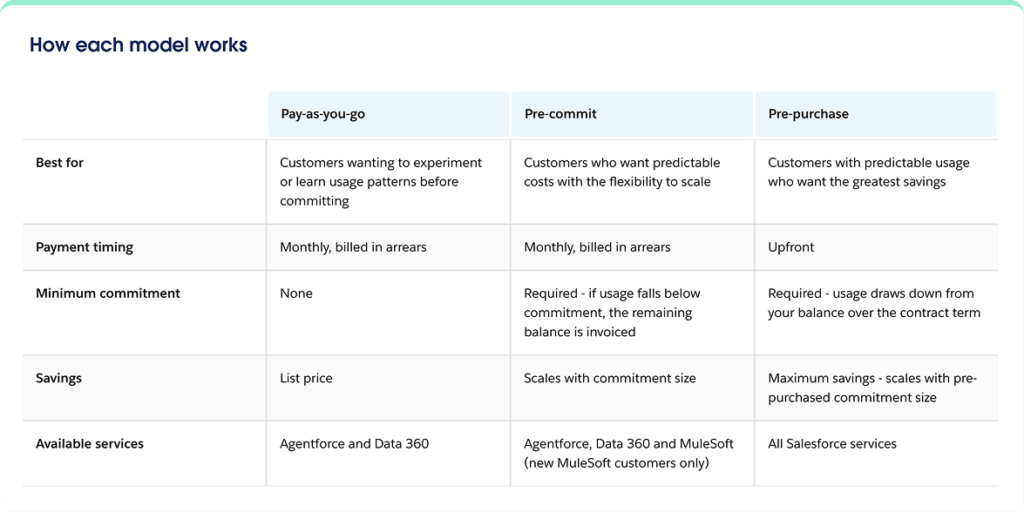
Image source: salesforce.com
Plan Salesforce Before You Buy
Map licenses, integrations, and usage first, so you’re paying for the setup your teams actually need.
Salesforce’s product catalog gets big quickly, so this table is the useful starting point. It shows the major products, how Salesforce charges for them, and the first public price you can work with.
These are the live US prices verified on August 27, 2026.
Salesforce Product | Main Use Case | Available Plans / Editions |
|---|---|---|
Sales Cloud | Leads, opportunities, pipeline and sales management | Free Suite, Starter, Pro, Enterprise, Unlimited, Agentforce 1 Sales |
Service Cloud | Customer service, cases and support | Starter, Pro, Enterprise, Unlimited, Agentforce 1 Service |
Marketing Cloud | Campaigns, journeys, B2B marketing, personalization and loyalty | Starter, Marketing Cloud Next Growth/Advanced, plus specialist products |
Commerce Cloud | B2C/B2B ecommerce and order management | B2C Growth, Plus, Premium; B2B Growth, Advanced |
Data 360 | Unified customer and operational data | Flex Credits, Profiles, Enterprise Profiles |
Agentforce | AI agents for customer and employee work | Foundations, Flex Credits, Conversations, User License, Flat Fee Access, Help Agent |
Salesforce Platform | Custom Salesforce applications | Platform Login & Dev Credits, Starter, Plus |
Industry Clouds | Industry-specific sales, service and operational workflows | Editions vary by industry |
Field Service | Dispatch, technicians, contractors and mobile service | Dispatcher, Technician, Contractor, Contractor Plus, Field Service Plus, Agentforce 1 Field Service |
Revenue Cloud | Quoting, subscriptions, contracts, orders and billing | Growth, Advanced, Revenue Cloud Billing |
Partner Cloud | Reseller, distributor and partner management | PRM, Partner Ecosystem Management, Channel Revenue Management |
Slack | Employee collaboration and Salesforce-connected work | Pro, Business+, Enterprise+ |
Tableau | Reporting, dashboards and analytics | Viewer, Explorer, Creator; wider analytics products available |
MuleSoft | APIs, system connections and automation | Anypoint Platform, MuleSoft Automation |
This is why Salesforce pricing plans 2026 can’t sensibly be reduced to a “$25 to $550 per user” range. Marketing Cloud can charge by the organization, Commerce can follow transaction economics, Data 360 can charge by consumption or profiles, and Agentforce introduces several different usage meters.
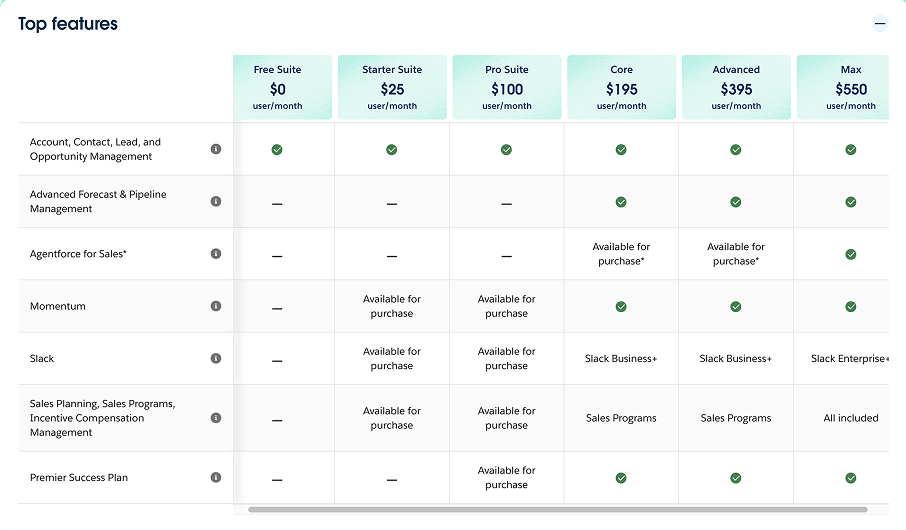
Image source: salesforce.com
Sales Cloud is Salesforce’s core system for managing leads, accounts, opportunities, forecasting and the work around closing a sale. For a small business, that might mean a handful of reps tracking incoming leads. For a larger company, it can support regional teams, complex account structures, and channel sales.
Current Salesforce pricing plans for Sales Cloud start at $0 with the free suite, the paid ladder then jumps from $25 to $100, $195, $395 and finally $550 per user/month.
Sales Cloud edition | Current US price | Billing |
|---|---|---|
Free Suite | $0/user/month | Free |
Starter Suite | $25/user/month | Monthly or annual |
Pro Suite | $100/user/month | Annual |
Enterprise | $175/user/month | Annual |
Unlimited | $350/user/month | Annual |
Agentforce 1 Sales | $550/user/month | Annual |
The Salesforce license pricing jump from Pro to Enterprise is easier to judge once API access is included. Pro costs $100/user/month, plus $25 for Web Services API access. Enterprise is $175 with API access and broader pipeline, reporting, and sales features. For 100 users, that’s $12,500 versus $17,500 per month. The question is whether Enterprise gives the team $5,000 worth of extra value.
Unlimited doubles Enterprise to $350/user/month, but bundles Premier Success, a Full Sandbox, Sales Engagement, and predictive AI. Those inclusions matter if you’d otherwise pay for them separately.
Agentforce 1 Sales rises again to $550/user/month. It bundles Slack Enterprise+, Tableau Next, Sales Planning, Spiff, Sales Programs, Salesforce Maps, unmetered employee Agentforce usage, and annual org-level credits. That can work for companies already buying several of those products. It’s much harder to justify for a small team that mainly wants occasional AI assistance.
At the other end of the Salesforce price per user range, Free Suite and Starter may be enough for smaller teams. Five users with straightforward Salesforce CRM for small business needs don’t automatically need Enterprise.
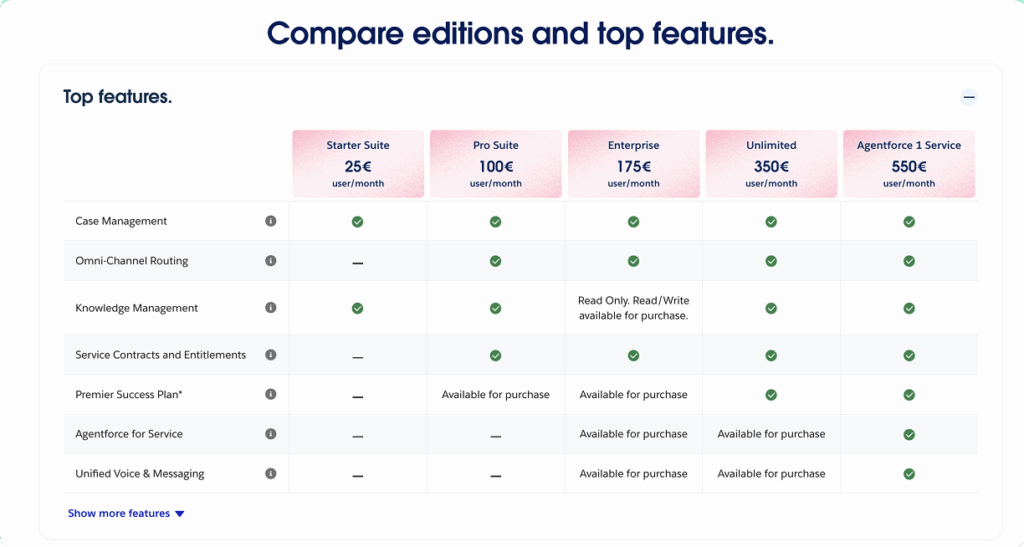
Image source: salesforce.com
Salesforce pricing plans for Service Cloud look familiar if you’ve just read the Sales Cloud table. The numbers are the same. What you get for them isn’t. Salesforce currently charges $25, $100, $195, $395, and $550 per user/month across its five Service editions. Starter can be paid monthly or annually; the rest require annual billing.
Service Cloud edition | Current US price | Best fit |
|---|---|---|
Starter Suite | $25/user/month | Small support teams handling straightforward cases |
Pro Suite | $100/user/month | Growing support operations needing more automation |
Enterprise | $195/user/month | Larger service desks and complex support teams |
Unlimited | $395/user/month | High-volume or business-critical service operations |
Agentforce 1 Service | $550/user/month | Teams making AI a serious part of agent work |
Enterprise is where Salesforce cost per user can climb quickly. The base license is $195/user/month, but read/write Knowledge, Einstein Bots, and Enhanced Messaging can each add $75/user/month. Pro customers also pay $25/user/month for Web Services API access. Agentforce for Service adds $125/user/month for unmetered employee AI use. (Salesforce.com)
Customer self-service is priced differently: Help Agent is $2 per successful resolution, while Agentforce Service Portal costs $4 per login or $10 per member. (Salesforce.com)
So don’t multiply headcount by $195 and call it the budget. Price the actual mix of case workers, Knowledge authors, messaging users, portal customers, AI users, and Field Service teams.
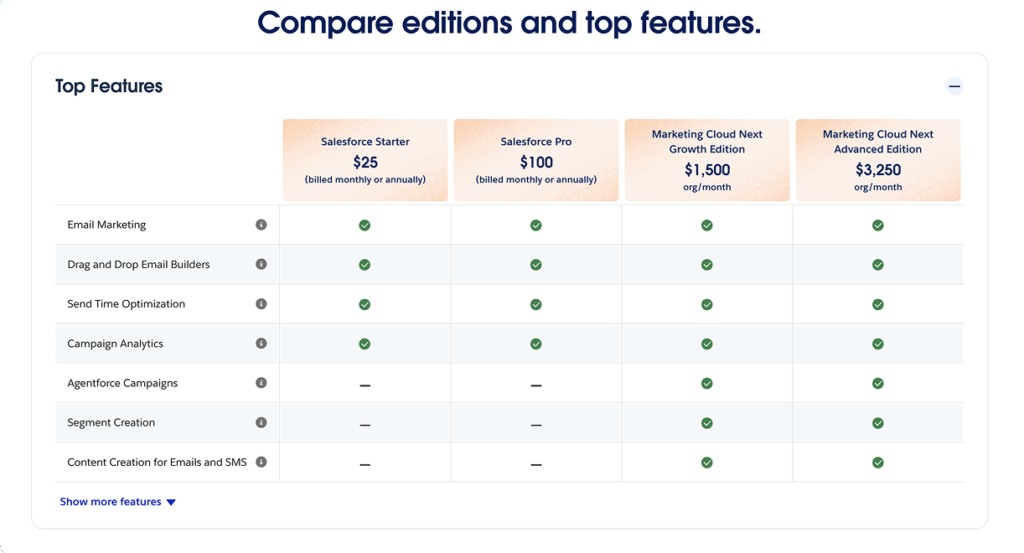
Image source: salesforce.com
Marketing Cloud is where Salesforce costs stop behaving much like conventional CRM licensing. The main Marketing Cloud Next products are sold per organization, while other products bring contacts, messages, credits and extra business units into the bill.
Salesforce has also changed the naming quite a bit. Older guides built around Marketing Cloud Engagement or the old Account Engagement editions can be misleading now. The current US pricing page puts Marketing Cloud Next Growth and Advanced front and center, then sells specialist marketing products and “+” editions around them.
Current marketing product | Public US price | Pricing unit |
|---|---|---|
Salesforce Starter | $25 | user/month |
Salesforce Pro | $100 | user/month |
Marketing Cloud Next Growth | $1,500 | org/month, billed annually |
Marketing Cloud Next Advanced | $3,250 | org/month, billed annually |
Salesforce Personalization | $8,000 | org/month, billed annually |
Marketing Intelligence | $10,000 | org/month, billed annually |
Loyalty Management | $20,000 | org/month, billed annually |
Account Engagement+ | From $1,250 | org/month, billed annually |
Engagement+ | $2,000 | org/month, billed annually |
Intelligence+ | $11,000 | org/month, billed annually |
Personalization+ | $15,000 | org/month, billed annually |
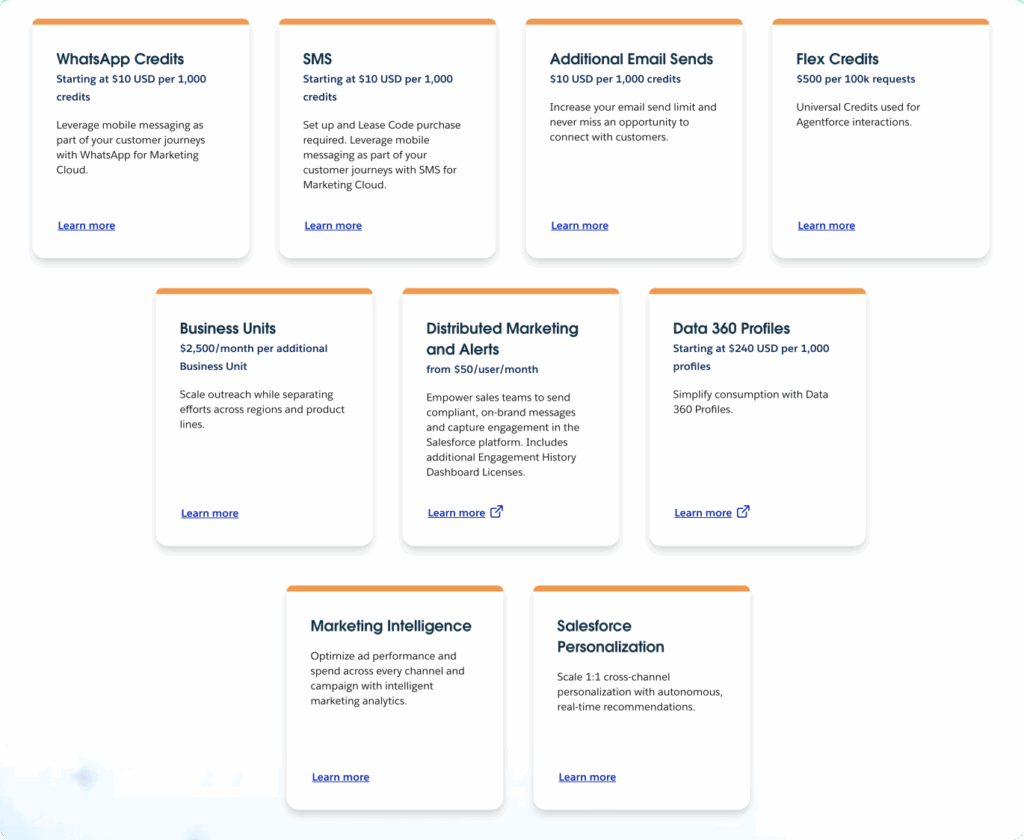
Image source: salesforce.com
Growth versus Advanced is really a $21,000-a-year question. Advanced costs another $1,750 per org/month and adds predictive scoring, path experiments, and unified SMS/WhatsApp conversations. If the team will use them, fine. If not, Growth may be the saner place to stop.
Account Engagement+ then runs from $1,250 to $15,000/org/month, depending on edition. The first three tiers include 10,000 contacts; Premium+ includes 75,000. Extra contacts come in blocks of 10,000 at $100/month.
Usage sits on top. SMS, RCS, WhatsApp, and extra email sends are $2 per 1,000. Another Business Unit costs $2,500/month.
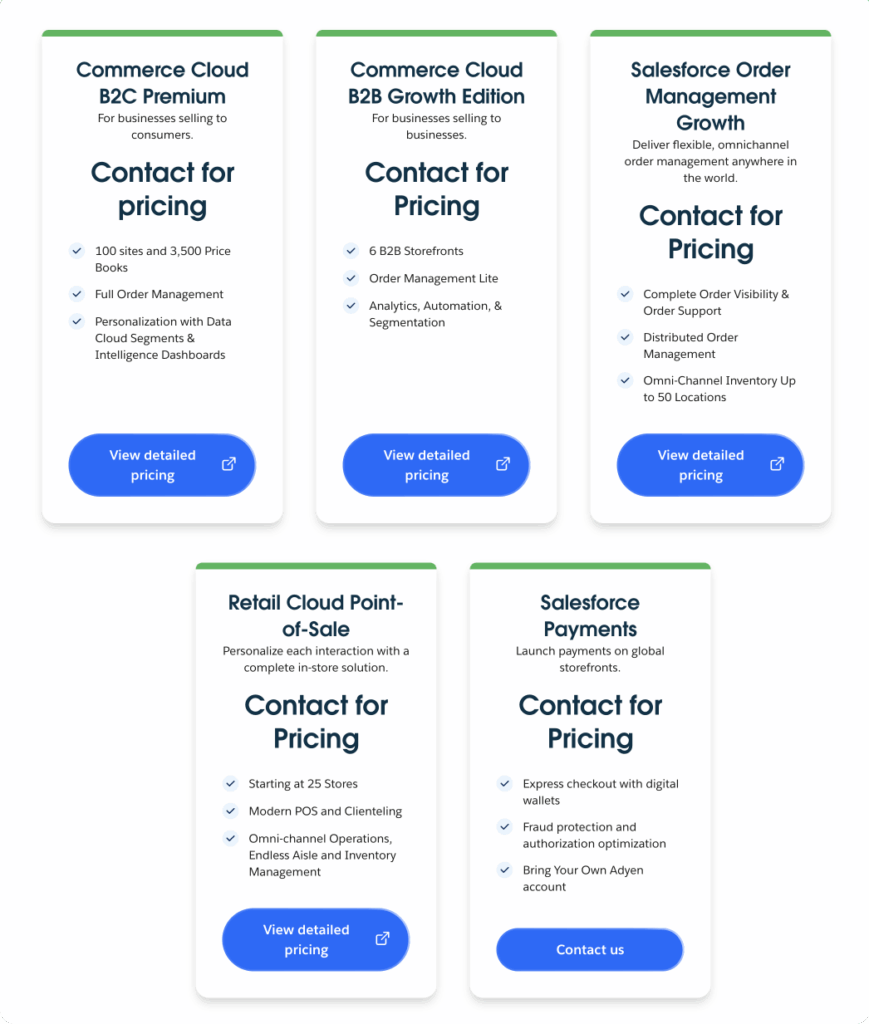
Image source: salesforce.com
Commerce is where Salesforce fees stop following the familiar “users × monthly licence” equation. Salesforce currently keeps most Commerce Cloud prices behind a sales quote, and B2B Commerce can be tied directly to the value of merchandise moving through the storefront.
Commerce product | Current options | Public price |
|---|---|---|
B2C Commerce | Growth, Plus, B2C Premium | Contact Salesforce |
B2B Commerce | Growth, Advanced | Contact Salesforce |
Salesforce Order Management | Order Visibility, Growth | Contact Salesforce |
Point of Sale | Commerce add-on | Request a quote |
Salesforce Payments for B2C | Commerce add-on | Request a quote |
B2C Commerce is quote-only, but the tiers still differ materially. Growth supports five sites and 10 price books; Plus raises that to 100 sites and 3,500 price books. Premium keeps those limits and adds Full Order Management, Data Cloud personalization, CRM Analytics users, and 500,000 Data Cloud credits.
B2B Salesforce license cost pricing is tied to Gross Merchandise Value, excluding tax and shipping. Growth includes six storefronts, Order Management Lite, and 250,000 Data Cloud credits; Advanced moves to 10 storefronts, Full Order Management, richer personalization, and 500,000 credits. Salesforce doesn’t publish the GMV percentage.
Orders coming from outside the Commerce storefront can also trigger separate Order Management charges. Standalone Order Management is quote-based, with Growth covering distributed order and inventory management across up to 50 locations.
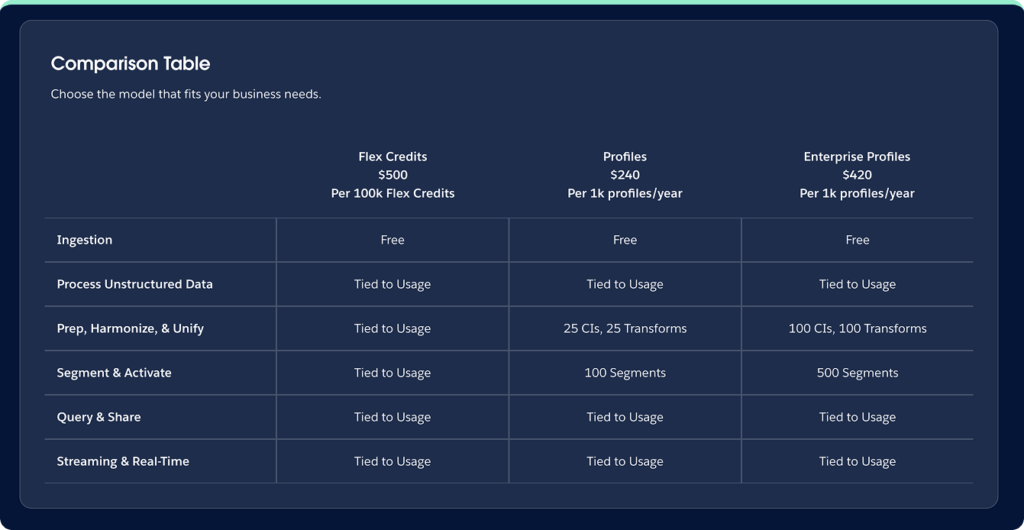
Image source: salesforce.com
Salesforce now calls Data Cloud Data 360, although “Data Cloud” still appears throughout older contracts, documentation and Salesforce editions. SFDC pricing is much easier to misunderstand than a normal CRM seat because the amount paid can move with data activity after the system is live.
The current public Salesforce CRM cost choices look like this:
Data 360 option | Current US price | What you’re paying for |
|---|---|---|
Flex Credits | $500 per 100,000 credits | Data 360 actions as they’re used |
Profiles | $240 per 1,000 profiles/year | Profile-building activity, with 1 Flex Credit per profile |
Enterprise Profiles | $420 per 1,000 profiles/year | Wider included profile activity, with 2 Flex Credits per profile |
Data 360 Starter | $60,000/year | Starting package with 10M Flex Credits and 5TB storage |
Data 360 Provisioning | $0 | Smaller entitlement for Salesforce products that rely on Data 360 |
Data 360 or SDFC license cost comes down to profiles and consumption. Flex Credits cover Data 360 activity and can move between Data 360 and Agentforce; profile pricing is more predictable, but queries and unstructured-data processing can still burn credits.
Data 360 Starter is $60,000/year, with 10 million Flex Credits and 5TB of storage. The $0 Provisioning SKU includes 250,000 credits and 1TB for customers using Salesforce products that depend on Data 360. Agentforce 1 Sales and Foundations can include Data 360 allowances too, so check what you already have before buying more.
Ingestion is free, including batch and zero-copy integrations. Preparation, unification, querying, sharing, streaming, and real-time processing can cost credits. Even Zero Copy Sharing is billable.
The hard part is estimating activity, not user count. Salesforce’s calculator can model it, while Digital Wallet shows actual consumption. Existing customers should also check their contract: credits bought before February 24, 2026 may still use the older Data Services Credits model.
Once Data 360 starts feeding Agentforce or high-volume journeys, the spend can move well beyond the cost of Salesforce CRM licenses.
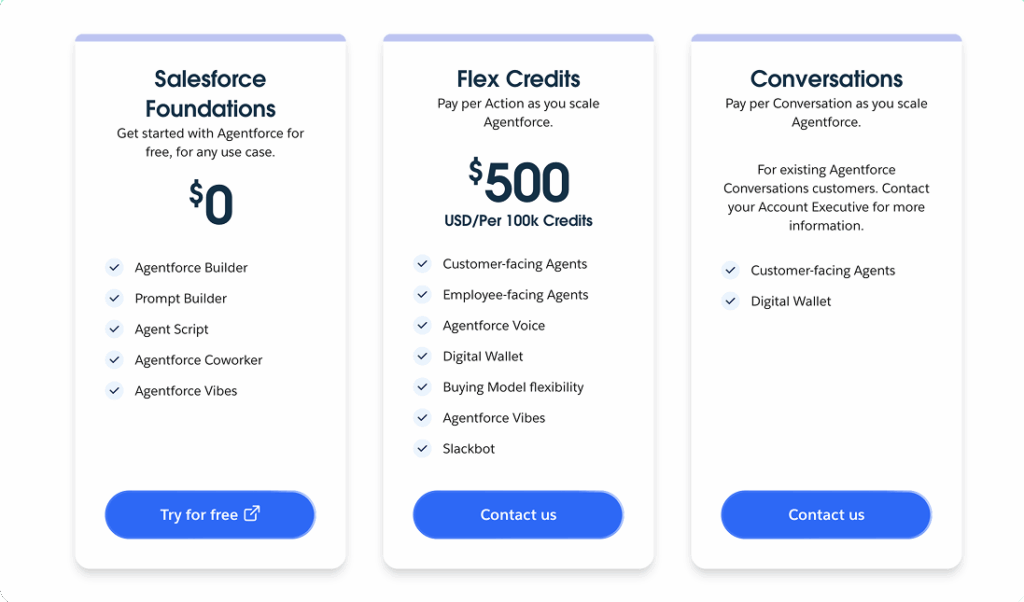
Image source: salesforce.com
Agentforce has several pricing models, which is where Salesforce pricing for AI gets harder to budget than a normal user license. Customers can pay for actions, conversations, successful resolutions, employee access, or a bundled Agentforce 1 edition.
Agentforce option | Current US price | What you pay for |
|---|---|---|
Salesforce Foundations | $0 | Entry access to Agentforce tools |
Flex Credits | $500 per 100,000 credits | Agent actions |
Conversations | $2/conversation | Customer-facing AI conversations |
Help Agent | $2/resolution | Successfully resolved support issues |
Agentforce User License | $5/user/month | Employee access; Flex Credits still required |
Agentforce add-on | $125/user/month | Unmetered employee use for Sales, Service or Field Service |
Industries add-on | $150/user/month | Unmetered industry-specific employee use |
Agentforce 1 Editions | From $550/user/month | CRM, AI and wider Salesforce bundle |
Flex Credits are the most granular Salesforce pricing option. Standard Agentforce actions use 20 credits and Voice actions 30; at $500 per 100,000 credits, a standard action works out to about $0.10 before related data usage.
Help Agent is simpler at $2 per successful resolution, with Agentforce actions and Data 360 queries included during that resolution.
For employees, the $5/user/month Agentforce User License still needs Flex Credits. The $125 Sales, Service, and Field Service add-on includes unmetered employee use; Industries costs $150. Agentforce 1 bundles start at $550/user/month for Sales and Service, rising to $650 for Field Service.
Teams scaling beyond a pilot may want help from the best Salesforce Agentforce partners to model actions, data calls, and handoffs.
Salesforce also offers Pre-Purchase and PayGo. Pre-Commit is still rolling out more broadly in 2026, and unused Flex Credits don’t roll over, so overbuying can waste budget.
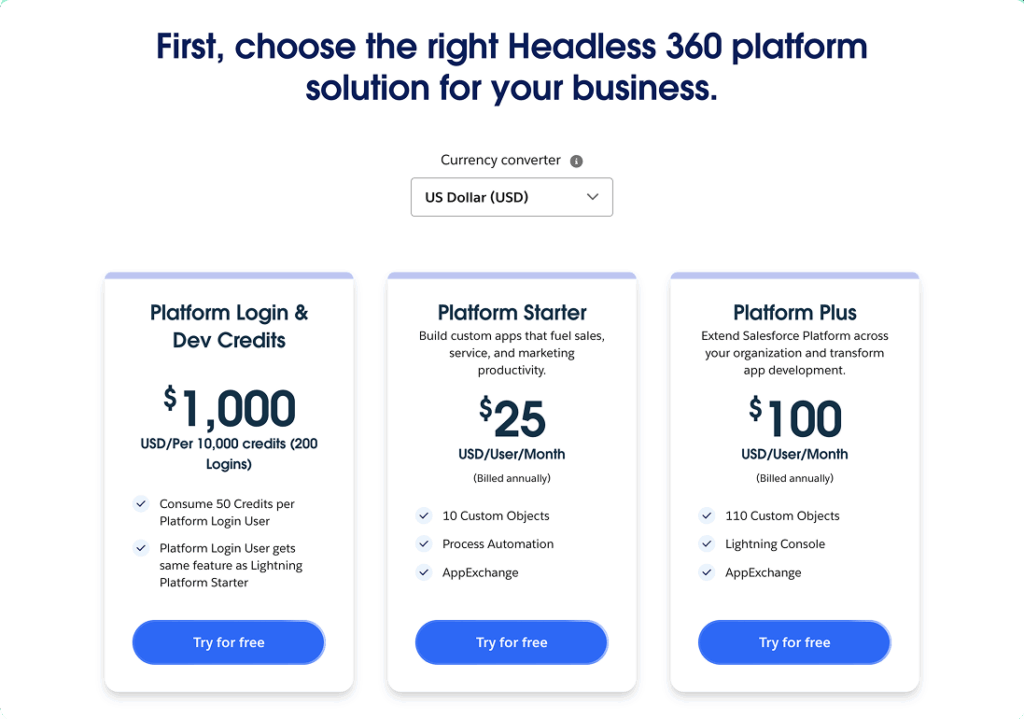
Image source: salesforce.com
Salesforce Platform is aimed at companies building custom apps and workflows on Salesforce. It can cost much less than a full Sales or Service Cloud licence when somebody needs the underlying platform rather than the complete CRM feature set.
Platform option | Current US price | Main use |
|---|---|---|
Platform Login & Dev Credits | $1,000 per 10,000 credits | Occasional login-based access |
Platform Starter | $25/user/month, billed annually | Custom apps with up to 10 custom objects |
Platform Plus | $100/user/month, billed annually | Broader apps with up to 110 custom objects and Lightning Console |
10,000 Login & Dev Credits equal 200 logins, based on 50 credits per login. Lightning Console costs another $25/user/month when added to Starter or login-based licensing.
For a company, Platform could suit employees using a purpose-built internal app who don’t need full opportunity or service functionality. It shouldn’t be treated as a cheap substitute for a Sales or Service license where those features are actually required.
That’s the important distinction behind how much is a Salesforce license. A $25 Platform seat and a $175 Enterprise seat give users very different access.
The core CRM license can be only one part of the Salesforce cost. Analytics, integration, portals, field operations and industry functionality can introduce separate per-user, per-login, organization-level or percentage-based charges. More importantly, some products depend on licenses you’re already paying for, while others are bundled into higher Salesforce editions. That’s why Salesforce offers a calculator to help.
Here are the extras most likely to move a serious Salesforce budget:
Product / add-on | Current US pricing | What to watch |
|---|---|---|
Slack | Pro $7.25/user/mo; Business+ $15; Enterprise+ quote | Check bundles. Agentforce 1 Sales includes Enterprise+. |
Tableau / analytics | Tableau from $15/user/mo; Tableau Next $40; CRM Analytics Growth $140; Plus $165 | Tableau Next may already be bundled. Data 360/AI usage can add consumption costs. |
MuleSoft | Quote | Integration costs depend heavily on systems and scope. |
Field Service | Dispatcher/Technician $175; Contractor $55/user or $22/login; Plus $230; Agentforce 1 $650 | Requires Service Cloud; technicians/contractors also need a Dispatcher. |
Experience Cloud | Quote | Compare login and member pricing against actual external-user frequency. |
Revenue Cloud | Growth $150/user/mo; Advanced $200; Billing quote | Annual contracts; prerequisite Salesforce licenses may apply. |
Industry Clouds & add-ons | Varies | Compare bundled industry features with separate licenses and custom development. Check prerequisites and limits. |
Success Plans | Standard included; Premier 30% of net license fees; Signature quote | Premier is bundled with Unlimited and Agentforce 1. |
Additional sandboxes | Developer included; Dev Pro 5% of net spend; Partial 20%; Full 30% | Higher editions may already include them. |
Extra CRM storage | Quote | Allowance varies by edition and user count. |
Industry Clouds can look expensive beside standard Salesforce editions. The comparison gets fairer once you account for the core Cloud functionality, specialist data models, and industry workflows already included. Price that against the separate licenses, integrations, and custom development you’d need without the bundle.
The same rule applies elsewhere. A $40 Tableau Next license may already sit inside another package. A $175 Field Service license may require another Salesforce license to work as intended. Premier support can cost 30% of net license fees in one configuration and be bundled at no additional charge in another. Before adding any published Salesforce price to a spreadsheet, check the prerequisite and the bundle.
The license quote is the easy number to see. It’s also the one most likely to give buyers an unpredictable answer to “how much is Salesforce per month?”
Salesforce has to be configured around the way the business already works. Customer and account data may need cleaning. ERP, finance, ecommerce, marketing, support, or proprietary systems may need connecting. Teams need training. Someone still has to own releases, permissions, broken automations, data issues, and new requests after go-live.
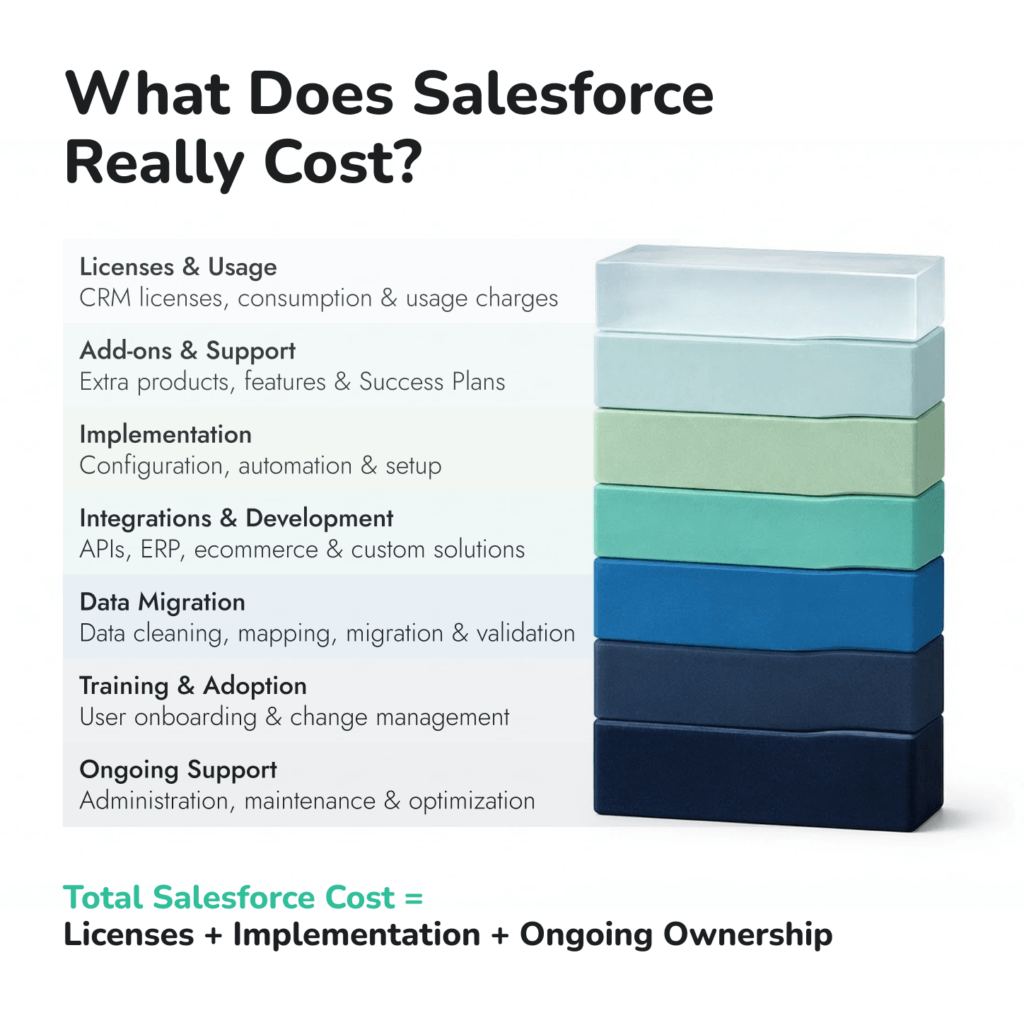
A Salesforce-commissioned Forrester study can help here. For its composite $2.3 billion manufacturer, Forrester modeled $7.67 million in three-year present-value costs. Salesforce subscriptions and add-ons accounted for $3.6 million. Another $2 million went to implementation and integration, with roughly $2.1 million allocated to change management, training, and ongoing administration.
A practical TCO for Salesforce plans and pricing should therefore account for:

Salesforce licenses and usage charges
paid add-ons and support
implementation and configuration
integrations and custom development
data cleansing and migration
training and change management
ongoing administration and technical support
There’s no fixed Salesforce professional services pricing for implementation because two projects with the same user count can be completely different. Twenty reps working from clean CRM data is one job. Twenty people across sales, service, and finance, with ERP, billing, ecommerce, and legacy integrations, is another.
The hours usually disappear into customization, automation, custom development, data cleanup, and integration design. Before an API gets built, somebody still has to decide which system owns each record, how often it syncs, and what happens when data conflicts or updates fail.
That makes scope a better way to compare Salesforce implementation partners than the headline quote. Check what each price actually covers, including migration, integrations, testing, documentation, training, and support after launch.
Price the Project Before You Commit
Work out the real scope behind Salesforce, including data, integrations, automation and delivery effort, before a license quote turns into a much larger project.
Salesforce rarely exists alone, so integration can become a sizeable part of the project. Connecting an ERP, finance system, ecommerce platform, support stack, data warehouse, or proprietary app all adds work.
Complexity matters more than the number of connections. A nightly customer export is simple, but a two-way ERP integration handling orders, account relationships, duplicates, failed API calls, and sync conflicts isn’t.
You may hire a dedicated Salesforce developer for custom solutions when standard connectors and Flow fall short, whether that means APIs, Apex, Lightning components, middleware, or bespoke logic.
“Move the old CRM into Salesforce” sounds like one task. It rarely is.
Salesforce pricing for migration depends on how much data is coming across, how many systems hold it, and how much cleanup is needed before anyone should trust it. Ten million well-structured records may be easier to migrate than a much smaller collection spread across a CRM, spreadsheets, finance software, and an aging legacy system.
Field mapping can take time when the old and new systems describe the same thing differently. Deduplication gets harder when one customer appears several times under slightly different names or email addresses. Transformation is needed when dates, status values, account structures, or product records don’t match the Salesforce model.
Validation deserves its own budget too. A migration hasn’t worked simply because the row count matches. Teams need to check that owners, relationships, historical activities, required fields, and downstream automations still make sense once the data lands.
Salesforce training doesn’t have to mean sending every employee on an expensive course. It does mean budgeting for people to learn the version of Salesforce they’ll actually use at work.
Administrators need enough knowledge to manage permissions, automation, reports, data quality, and routine changes without turning every request into a consulting ticket. End users usually need something much more specific. A salesperson may only need to know how leads are assigned and updated. A service advisor may care about appointments, customer history, and follow-up tasks.
Salesforce offers free self-paced learning through Trailhead, which can reduce the cost of general product education. Company-specific onboarding still takes time to design and deliver because Trailhead can’t teach employees the workflows, terminology, approval rules, or data standards built into their own implementation. Some companies even invest in Salesforce consulting services that provide custom training.
Salesforce doesn’t become maintenance-free once the implementation team leaves.
There are several different costs hiding under the word “support.” Salesforce’s own Success Plans cover assistance with the Salesforce product. Standard Success is included with licenses, while Premier is priced separately for eligible editions and Signature is quote-based. Higher-tier Salesforce editions may already include Premier, so this is an area where buyers should check the bundle before adding another line to the budget.
Go-live doesn’t end the work. Someone still has to fix automation, chase failed integrations, change permissions, test releases, clean data, and deal with the requests that start piling up once people actually use Salesforce.
An internal team can own it, an outside partner can, or both can share it. Whatever the setup, support adds to the real Salesforce CRM pricing.
In-House, Contractor, or Salesforce Partner: What Will It Cost?
Salesforce work rarely arrives in a neat, steady stream. An admin may have plenty to do every week, while a developer is needed for one integration and an architect only turns up for a redesign or Agentforce project.
That makes permanent hiring expensive pretty quickly. Indeed’s current US salary data puts average base pay at about $91,700 for Salesforce Administrators, $120,200 for Developers, and $135,600 for Consultants. Benefits, recruitment, payroll costs, and onboarding come on top.
Option | Cost benchmark | Usually suits |
|---|---|---|
In-house | In-house Admin ~$91.7k; Developer ~$120.2k; Consultant ~$135.6k base pay | Steady work throughout the year |
Contractor / freelancer | Varies by role and experience | Defined builds, migrations, or backlog work |
Staff augmentation / partner | No reliable universal US rate | Workloads where the skills mix keeps changing |
Those models aren’t directly comparable. A contractor’s hourly rate includes a different cost structure from an employee salary, while partner pricing may cover several skills rather than one permanent role.
That flexibility is already common, 71% of Salesforce teams use an external partner or systems integrator for at least some development work.
So Salesforce CRM cost doesn’t automatically mean hiring an admin, developer, consultant, and architect. Salesforce staff augmentation services can make more sense when the work comes in bursts or the role you need changes from one project to the next.
Get the Salesforce Skills You Need
Add specialist capacity when the workload calls for it, without carrying every Salesforce role on payroll all year.
If you’re wondering why Salesforce is the best CRM when the pricing is so complicated, it’s worth remembering other platforms can be tricky too.
CRM | Entry paid plan | Higher-tier example |
|---|---|---|
Salesforce Sales Cloud | Starter $25/user/mo | Enterprise $175; Unlimited $350 |
HubSpot Sales Hub | Starter $20/seat/mo list | Professional $100; Enterprise $150 |
Dynamics 365 Sales | Professional $65/user/mo | Enterprise $105; Premium $150 |
Zoho CRM | Standard $14/user/mo | Enterprise $40; Ultimate $52 |
Pipedrive | Lite $14/seat/mo | Premium $59; Ultimate $79 |
If you’re looking at Salesforce vs other CRM options in pricing terms, Salesforce Sales Cloud Enterprise is $175 per month, so 100 cloud seats would be $210,000 per year. Dynamics Enterprise would cost $126,000 for those same 100 users, and Zoho Enterprise, $48,000.
Salesforce therefore has quite a lot to prove. If it’s replacing other systems or supporting processes the cheaper CRM would struggle with, fine. If most users need contacts, opportunities, forecasts, and ordinary sales automation, paying another $84,000 or $162,000 a year deserves a very good explanation.
Salesforce plans and pricing get expensive when buying decisions get made before the operating model does. A business can end up with full Sales or Service licenses for people who barely touch CRM, an upgraded edition to solve one awkward workflow, or another Cloud added before anyone has worked out whether the existing stack could handle the job.
Routine Automation works from the requirement backwards. That can mean mapping users to the cheapest sensible license, configuring what Salesforce already includes, connecting ERP, finance, marketing, ecommerce, support, or proprietary systems, cleaning and moving data, and building the custom pieces that are genuinely needed.
There’s also the question of who keeps it running. Routine Automation can handle ongoing Salesforce work or plug specific gaps through staff augmentation, rather than forcing a company to hire a permanent admin, developer or architect for workload that comes in bursts.
The useful question isn’t “what else can we buy?” It’s “what does this process actually need?” That usually produces a much healthier Salesforce budget.
Control Your Salesforce Costs
Match licenses, integrations and automation to the work your teams actually need before unnecessary complexity becomes recurring spend.
Salesforce can be worth the money. The advertised Salesforce license pricing is still a pretty poor way to decide.
There’s no single Salesforce price because the bill changes with the product, edition, number and type of users, consumption, add-ons, implementation work, integrations, customization, and the people needed to keep the system useful after launch. A $175 Enterprise seat tells you very little about what the finished Salesforce environment will actually cost.
That matters whenever Salesforce has to sit at the center of several business systems. Connecting sales, finance, service, marketing, ecommerce, and customer data can make the implementation far more consequential than the initial license choice.
So build the budget around the system you expect to operate, including the work required to get there and maintain it. Then compare that total with the commercial value Salesforce is supposed to deliver.
On September 3, 2026, Salesforce replaced the Enterprise, Unlimited, and Agentforce 1 editions of Sales Cloud and Service Cloud (and the equivalent Industries Cloud editions) with new Core, Advanced, and Max editions, for new customers only. This applies only to Sales Cloud, Service Cloud, and Industries Clouds, pricing for Marketing Cloud, Commerce Cloud, Data 360, Revenue Cloud, and Platform is unaffected.
These aren’t simple renames: every new tier (Core, Advanced, Max) now bundles Slack, Tableau Next, the Premier Success Plan, and native data security as standard, plus a Flex Credits allocation.
New list pricing: Core $195/user/month, Advanced $395/user/month, Max $550/user/month (unchanged from Agentforce 1).
Customers with existing Sales Cloud / Service Cloud contracts on Enterprise, Unlimited, or Agentforce 1 tiers are unaffected, legacy naming and pricing continue to apply to them.
Figures elsewhere in this article reflect list pricing as of the dates noted in that section.
Source: salesforce.com|news
That depends on the product and edition. Sales Cloud and Service Cloud currently start at $25 per user/month, while Enterprise is $175, Unlimited is $350, and Agentforce 1 is $550. If you’re asking, “how much is Salesforce per month?”, watch the billing terms too. Most of the bigger editions are sold on annual contracts.
For standard Sales or Service Cloud, list prices run from $25 to $550 per user/month. That figure can rise once API access, Agentforce, messaging, industry products, or other usage-based charges are added.
Yes. Salesforce now has a Free edition of Sales Cloud for up to two users. It’s useful for testing the CRM or running a very small sales operation, although a growing team will probably hit the limits fairly quickly. Salesforce Foundations is free too, but paid usage can still apply when Agentforce or Data 360 starts consuming credits.
Sales Cloud Free costs nothing for up to two users. After that, Starter is the cheapest paid Sales and Service Cloud edition at $25 per user/month. Salesforce Platform Starter also costs $25, although it serves a different purpose and doesn’t give users the same CRM functionality as Sales or Service Cloud.
Ten Starter licenses cost $250 per month at list price. Ten Pro licenses cost $1,000. That gives a small business a much more useful starting figure than a broad “Salesforce is expensive” label, although the budget changes fast if the company needs API access, imported legacy data, custom automation, or connections to other software.
There’s no fixed implementation fee. A clean Sales Cloud setup with limited customization may be relatively small; multiple Clouds, old data, custom workflows, and integrations can turn it into a much bigger job. Salesforce Professional Services is quote-based, so scope has to come first.
In some packages, yes. Agentforce 1 editions include Agentforce, and Salesforce Foundations gives eligible customers some Agentforce access at no additional license charge. Other customers can pay through Flex Credits, $2 Conversations, or employee add-ons starting at $125 per user/month. Included access and included usage aren’t always the same thing.