 Suomi
Suomi Français
 Deutsch
 Polski
Talk Through Your Agentforce Build
Bring your Salesforce setup, use case, and integration questions. Routine Automation can help with strategy workshops, architecture choices, and the technical work needed to put the agent into a real process.



Choosing a Salesforce Agentforce implementation partner can get surprisingly complicated faster than you’d think. Anyone can give a good demo. Good Salesforce Agentforce partners have to sort out the data, permissions, actions, handoffs, and old Salesforce automation sitting underneath the agent. Get the implementation wrong and you haven’t saved anyone time. You’ve given a faster system permission to make the same old mistakes.
Still, a certified Salesforce partner can help you take advantage of a solution that Salesforce is clearly putting a lot of weight behind.
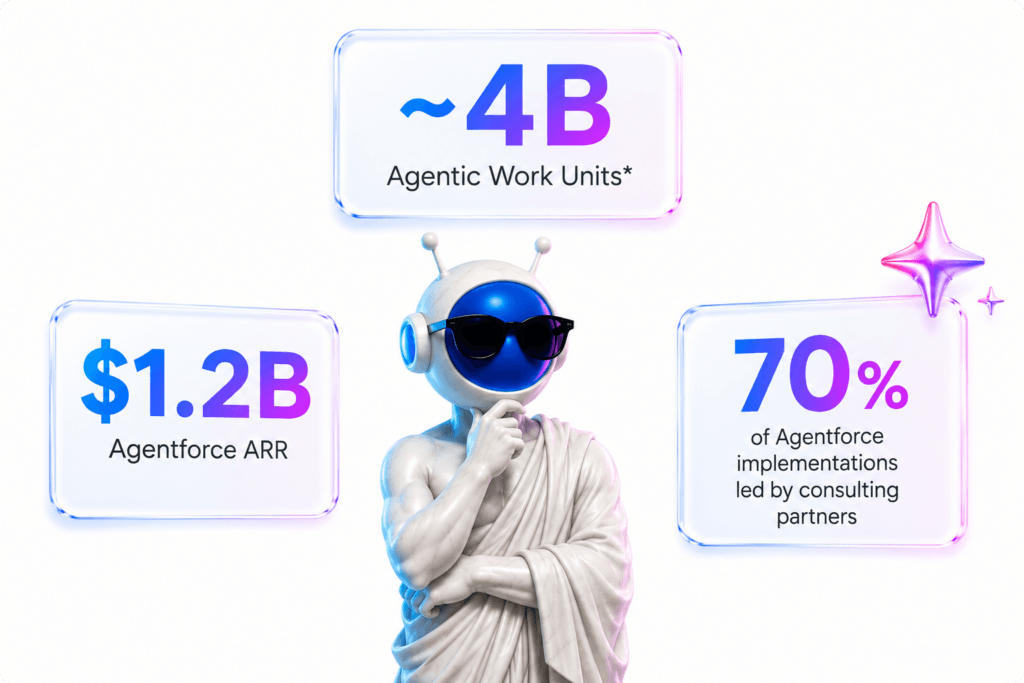
Agentforce reached $1.2 billion in annual recurring revenue in 2026, while Agentforce and Slack had delivered nearly 4 billion Agentic Work Units. More than half of Agentforce and Data 360 bookings came from existing customers, which matters. Most companies aren’t starting with a pristine Salesforce org. They’re adding agents to years of fields, Flows, integrations, duplicate records, and slightly mysterious admin decisions.
Salesforce also says consulting partners lead 70% of Agentforce implementations. That doesn’t make every partner equally capable. Some are brilliant with global data programs. Others are better when a mid-market team needs someone close to the actual work.
Before you start searching for a partner, there’s a question to answer: “What is Salesforce Agentforce?” It’s really the part of Salesforce used to build AI agents that can understand a request, pull approved business context, choose from a set of permitted actions, and complete work.
A proper Salesforce Agentforce implementation gives each agent a defined job, trusted data, clear instructions, access to specific Flows or APIs, and firm rules around approvals and handoffs.
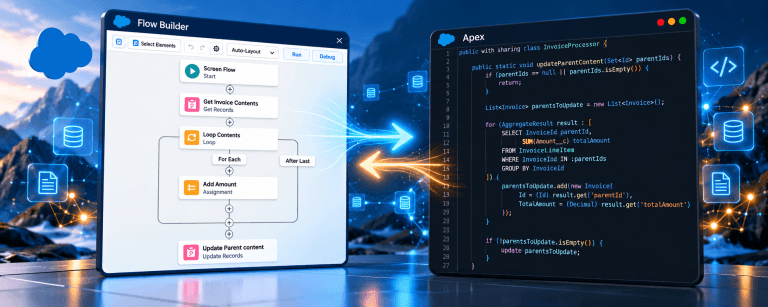
That makes an agent different from traditional Salesforce automation. Flow follows a route an admin has already mapped. Agentforce can interpret what someone is asking, decide which permitted action fits, then call Flow, Apex, an API, or another connected tool. Salesforce now refers to an agent’s specialist areas as “subagents,” previously called topics.
Area | Salesforce Flow | Agentforce |
|---|---|---|
How it decides | Follows fixed rules and branches | Interprets context and selects from approved actions |
Best use | Stable, repeatable processes | Requests involving language, context, or several possible routes |
What controls it | Entry criteria, conditions, permissions | Instructions, subagents, actions, permissions, and handoffs |
Common failure | Old or brittle automation | Weak context, vague rules, or too much authority |
Most companies won’t replace a dependable Flow because Agentforce looks newer. The stronger design usually lets the agent understand the situation, while tested automation handles calculations, approvals, and sensitive record changes. Salesforce’s Agent Script supports this mix of natural-language reasoning and fixed conditions.
Common use cases include:

Customer service: Answer questions, retrieve order history, search knowledge, prepare resolutions, and transfer harder cases with the conversation attached.
Sales: Research accounts, qualify leads, summarize activity, and prepare follow-up. The Agentforce for sales value depends heavily on the quality of account, contact, and opportunity data.
Employee support: Answer HR or IT questions and create requests, with strict access around payroll, health, identity, and performance records.
Marketing: Build audiences, prepare campaign work, interpret replies, and coordinate sales handoffs. Agentforce Marketing gets more useful when it can see consent, service history, and purchase activity.
Operations: Check documents, gather approvals, support onboarding, and coordinate work across Salesforce and connected finance, procurement, or ERP systems.
Implementation quality decides whether any of that produces a result worth keeping. An agent using duplicate accounts gives sales the wrong context. A service agent grounded in stale knowledge creates more cases. An operations agent with loose permissions can spread one bad decision across hundreds of records.
That’s where experienced Agentforce partners bring value. They decide which source wins when data conflicts, which actions need approval, what stays inside Flow, how failures are logged, and who owns the agent after launch.
You need an Agentforce implementation partner when the agent will do more than answer simple questions from clean Salesforce records. An experienced admin can handle a contained internal use case. The job gets much harder once the agent touches several clouds, outside systems, sensitive data, or actions that change live records.
A new rollout is the obvious trigger. The team needs to choose the first use case, define what the agent can see, build its actions, and decide when a person takes over. That work quickly spills beyond normal Salesforce administration.
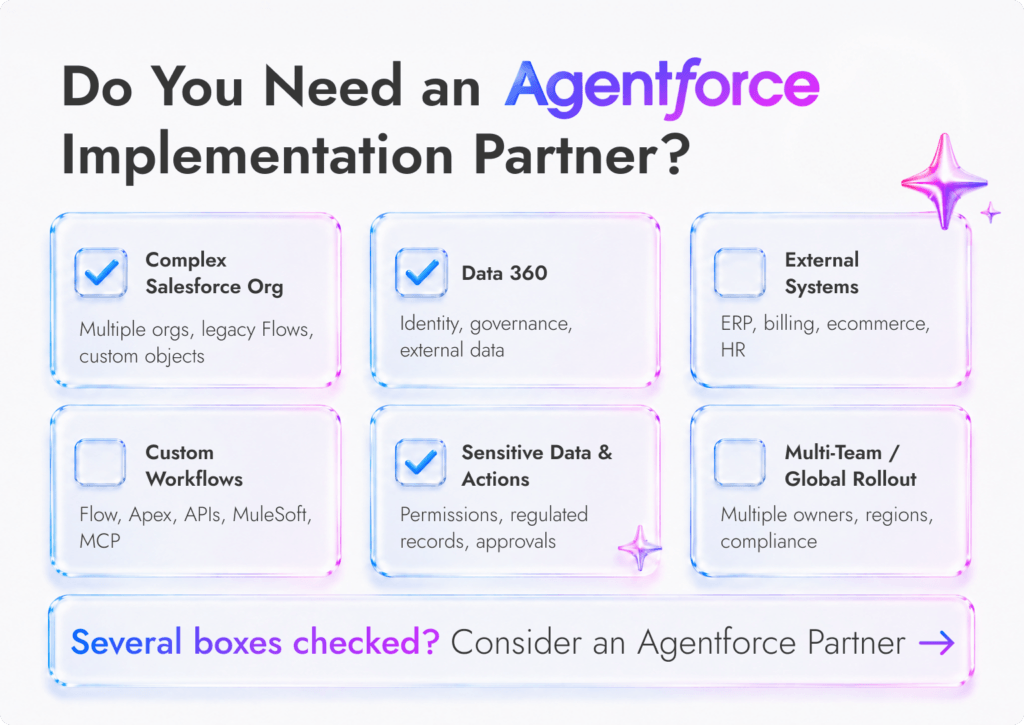
External help also makes sense when:

The Salesforce environment is already complicated. Old Flows, duplicate records, custom objects, several orgs, and unclear field ownership all shape the agent’s decisions.
Data 360, formerly Data Cloud, is involved. Identity matching, governance policies, external data, and access rules need to be settled before the agent can use that context safely.
The agent needs other systems. ERP, billing, ecommerce, inventory, telephony, and HR platforms require field mapping, authentication, failure handling, and a clear source of truth.
The workflow is custom. A standard service agent is one thing. An agent coordinating approvals, checking contract terms, then updating Salesforce and a finance system needs proper architecture.
Security carries real consequences. Permissions must control which records, fields, tools, and actions the agent can reach. Data governance can’t be patched in after launch.
The rollout crosses teams or countries. Enterprise projects bring regional rules, several owners, release processes, training, and support requirements.
Deployment is another trap. Salesforce can move agent metadata between environments, but the related Flows, Apex classes, Data 360 dependencies, and permissions still need to arrive in the right order. The agent user must also have access to every field and action it needs.
A good Agentforce implementation expert deals with those dependencies before the build reaches production. That usually costs less than discovering them after an agent has started updating customer records.
Consider outside help with Salesforce Agentforce implementation when a few of these apply:

The agent will update financial, customer, contractual, or regulated records.
It needs data from outside Salesforce.
Your CRM already has data-quality problems.
Several teams own parts of the process.
Legal, security, or compliance must approve the design.
Custom Flow, Apex, API, MCP, or MuleSoft work is required.
Nobody owns testing and monitoring after launch.
Your team couldn’t quickly reverse a bad bulk action.
Plan a Safer Agentforce Rollout
Get a practical plan for data, integrations, permissions, testing, governance, and recovery before your first production agent goes live.
The best Salesforce Agentforce partners can prove they’ve moved an agent from a promising demo into controlled production use. Salesforce Partner status matters, but the badge won’t tell you whether the assigned architect has handled failed API calls, weak source data, nervous compliance teams, or an agent that starts behaving differently after launch.
Salesforce now places consulting partners in Select or Summit tiers. Its newer program also replaced 170 broad distinctions with 28 focused competencies based on completed projects, customer satisfaction, and current credentials. That gives buyers better evidence than a giant company-wide certification number on its own.
This particular ranking uses the following criteria:
Evaluation area | What we looked for |
|---|---|
Salesforce standing and certifications | Current Partner status, relevant Agentforce credentials, verified projects, and named specialists |
Agentforce and AI experience | Production agents, testing methods, guardrails, human handoffs, and proof of results |
Industry knowledge | Experience with the buyer’s regulations, data model, workflows, and customer expectations |
Data and integration skills | Data 360, custom objects, field mapping, Flow, Apex, APIs, MuleSoft, MCP, and outside systems |
Customer evidence | Recent reviews, comparable case studies, reference calls, and honest accounts of what went wrong |
Enterprise delivery | Security reviews, several orgs or regions, deployment controls, adoption, and change ownership |
Long-term support | Monitoring, release testing, instruction updates, usage reviews, integration maintenance, and recovery planning |
The top Agentforce implementation partners should also explain what they would refuse to automate. That tells you whether the consultancy will challenge a risky process or happily build whatever appears in the statement of work.
If you need Salesforce Agentforce implementation services, don’t compare based on who has the biggest Salesforce practice. What you really need is a team that’s already dealt with the difficult parts of a project like yourst, whether that’s dirty CRM data, custom actions, Revenue Cloud, or an agent that needs to work across several systems.

Best for:
SMB and mid-market teams that don’t want discovery handed off to a different crew once the contract is signed.
Routine Automation is a Salesforce consulting and implementation partner that handles the setup, development, migration, integrations, testing, and the fixes that come after launch.
As one of the top Salesforce consulting firms for Agentforce, Routine Automation makes a tricky setup easier. A lot of companies find that a new agent exposes old problems elsewhere in the org. A broken Flow or badly mapped account field doesn’t become less broken when an LLM starts using it.
The company reports 293 completed projects and 27 engineers. AppExchange separately lists eight Salesforce-verified projects and 14 qualifying certified experts, so those figures shouldn’t be lumped together.
Key Industries:
Manufacturers Transportation providers Product Companies Automotive Retailers E-commerce Businesses Telecom Providers Energy Companies
Core Agentforce Services:

Salesforce Agentforce implementation services
Agent actions, permissions, and handoff design
Flow, Apex, API, and CRM automation
Data cleanup, migration, and field mapping
Pre-launch testing and support when something changes later
Why Choose Them:

Can fix the CRM work underneath the agent instead of treating Agentforce as a separate project.
Stays useful after launch, when instructions, fields, and integrations start changing.
Covers Salesforce and HubSpot handoffs.
Offers a closer delivery model than a global consultancy.
Put Agentforce to Work
Start with one useful agent, sound data, and actions your team can trust.
Best for:
Mid-market and enterprise teams with a mature Salesforce setup, several clouds, and enough custom architecture that a quick-start package would barely scratch the surface.
Noltic is one of the better picks among Agentforce implementation partners when you need a lot of technical support. Its AppExchange listing records 169 verified projects and 91 qualifying certified experts, while the company reports 400+ Salesforce certifications, eight architects, and 11 Agentforce Specialist credentials.
Those numbers matter less than the shape of the team behind them: Noltic has people working across data architecture, identity, integration, Revenue Cloud, and release management.
Key Industries:
Financial Services Healthcare Manufacturing Software Retail Nonprofit Sector
Core Agentforce Services:

Agentforce architecture and custom actions
Data 360 and multi-cloud delivery
Revenue Cloud and sales process work
API and platform connections
QA, deployment, and managed support
Why Choose Them:
The Agentforce implementation experts have relevant architecture and integration credentials, not only admin certifications.
Revenue Cloud experience helps when agents touch pricing, quotes, orders, or renewals.
AppExchange product work brings useful discipline around packaging, testing, and upgrades.
Better suited to custom engineering than a narrow configuration job.

Best for:
Large enterprises where Agentforce needs governed access to Snowflake, Data 360, several Salesforce clouds, or systems outside the CRM.
Coastal, formerly Coastal Cloud, joined forces with TCS in January 2026 bringing two groups of Agentforce consulting partners and implementation experts together. It brings more than 600 North American professionals, 3,091 certifications, and 442 credentials across Agentforce, AI, and Snowflake. The firm also holds seats on six Salesforce Partner Advisory Boards.
It’s one of the higher-ranked Salesforce consulting specialists and implementation partners on this list, with plenty of experience in high-ROI use cases.
Key Industries:
Financial Services Healthcare Manufacturing Public Sector Private Equity Education Technology
Core Agentforce Services:

Agent strategy and production delivery
Data 360, Snowflake, and zero-copy work
MuleSoft and external-system connections
Governance, testing, and managed agent operations
Why Choose Them:
The Agentforce integration specialists cover the awkward ground between CRM records and enterprise data.
Agentforce work includes use-case planning, cost modelling, testing, and monitoring after release.
TCS gives Coastal more reach for international programs.
A 90-day package can take two selected agents through pilot delivery, which gives buyers a defined starting point rather than an open-ended AI programme.

Best for:
Mid-market and enterprise teams adding Agentforce while rebuilding Revenue Cloud, Sales Cloud, Service Cloud, or an ageing Salesforce setup.
CloudMasonry lands in a useful middle ground. It’s bigger than a small Salesforce shop, but clients aren’t signing up for a giant international delivery model. The company reports 60+ US consultants, 350 certifications, 559 projects, and a 4.9 AppExchange score.
The Agentforce implementation experts focus on digital transformation strategies, which makes it a good pick for organizations of all shapes and sizes looking to take the next step with their tech.
Key Industries:
Financial Services Insurance Healthcare Energy Media Technology Professional Services
Core Agentforce Services:
Agentforce planning and setup
Revenue Cloud and quote-to-cash work
Data 360 and MuleSoft
Salesforce architecture and migration
Managed support
Why Choose Them:
Revenue Cloud experience helps when an agent touches pricing, quotes, orders, or renewals.
The team covers the older Salesforce machinery the agent will depend on.
CloudMasonry reports that 89% of its customers return for more than one project, useful evidence for buyers who expect the work to continue after launch.
US and UK coverage suits companies that want a relatively close delivery team without choosing a huge systems integrator.
Best for:
Mid-market organizations using Agentforce inside customer portals, member sites, partner channels, or self-service communities.
Advanced Communities is a Salesforce and Agentforce implementation company that thrives in projects where where access rules get awkward. External users need the right records, the right knowledge, and absolutely nothing else. The firm works heavily with Experience Cloud, PRM, Revenue Cloud, and Salesforce-native apps. AppExchange lists 139 verified projects and 57 certified experts.
It’s a popular choice for companies looking for the best Salesforce implementation companies to help with improving customer experience strategies.
Key Industries:
Membership Groups Nonprofits Education Providers Healthcare Teams Technology Businesses Manufacturers
Core Agentforce Services:
Agentforce setup and custom actions
Experience Cloud and PRM
Portal permissions and knowledge
Revenue Cloud workflows
CRM, ERP, WhatsApp, and web connections
Why Choose Them:
Understands sharing rules, guest access, partner records, and external-user permissions.
Can connect self-service agents with quoting, ordering, and case workflows.
Offers Salesforce-native apps alongside consulting.
Their 2026 Headless Revenue Agent turns a WhatsApp request into a Salesforce quote and order.
Best for:
Mid-market and enterprise teams connecting Agentforce with marketing, commerce, personalization, hospitality, or a large customer journey.
Horizontal Digital looks at Agentforce through the customer experience, which suits projects where the agent sits across a website, campaign, portal, and service handoff. The company reports 650+ cross-cloud certifications, 60+ Data 360-certified consultants, and 120+ Agentforce Marketing implementations.
The Agentforce partner also has an excellent reputation, and was named one of the top Digital partners of the year by Salesforce in 2026.
Key Industries:
Hospitality Real Estate Healthcare Financial Services Retail Manufacturing Consumer Goods
Core Agentforce Services:
Agentforce planning and accelerators
Data 360 and identity work
Agentforce Marketing
Experience Cloud and Commerce
MuleSoft connections
Why Choose Them:
They have deeper marketing-agent experience than most firms on this list.
Covers the awkward handoffs between campaign, commerce, portal, and service work.
Pairs Salesforce engineering with journey and interface design.
Joined Salesforce’s Forward Deployed Engineering Partner Network in 2026.
Best for:
Startups and mid-market teams that need Agentforce engineers, custom Salesforce work, or extra delivery capacity without hiring a large consultancy.
Synebo is more engineering shop than strategy house. It handles full Salesforce projects, AppExchange product work, white-label delivery, and staff augmentation. So, if you’re looking for certified developers for outsourcing Agentforce tasks, Synebo is probably a good pick.
The Agentforce implementation expert reports 1,000+ projects, 160+ employees, and 255+ certifications, too, which is a good sign that you’re getting an experienced partner.
Key Industries:
Software Fintech Companies Insurers Healthcare Providers Retailers Telecom Businesses Security Firms Manufacturers
Core Agentforce Services:
Agent design and configuration
Custom Flow, Apex, and integration work
Sales and Service agents
Testing and access controls
Ongoing admin and development support
Why Choose Them:
They let buyers choose between a full project and an outsourced team.
They have 10 Agentforce Specialist credentials on its current certification page.
AppExchange engineering experience helps with testing and release discipline.
The service works well when the internal team already owns strategy but needs more hands.
Best for:
Upper mid-market and enterprise rollouts where Agentforce will change jobs, approvals, service processes, or several departments at once.
Slalom makes more sense as an Agentforce partner when the people problem is as serious as the technical one. Its work covers Agentforce, Data 360, operating-model design, training, and adoption. Salesforce selected Slalom for its Forward Deployed Engineering Partner Network in April 2026, based on proven Agentforce delivery.
They’ve also been focusing heavily on the AI space lately, even launching their own AI research papers, reports, and webinars.
Key Industries:
Finance Healthcare Life Sciences Manufacturing Retail Government Travel Utilities Technology
Core Agentforce Services:
Use-case and readiness work
Agentforce and Data 360 delivery
Testing and governance
Training and change planning
Cross-cloud Salesforce programs
Why Choose Them:
Strong fit when several teams must agree on ownership and approval rules.
They have published production evidence rather than only demo claims.
Their Avetta project cut service handle time by 25%, raised containment from 20% to 49%, and improved chat deflection by 38%.
Local consulting teams can pull in wider Salesforce and industry specialists.

Best for:
Large enterprises where Agentforce has to work across several countries, business units, Salesforce clouds, and existing technology programmes.
Accenture is the sensible choice when the org chart is almost as complicated as the tech stack. The firm reports 55,000+ Salesforce-skilled employees and 78,000+ Salesforce certifications, and it joined Salesforce’s Forward Deployed Engineering Partner Network at launch.
It’s not the first company smaller, budget-focused businesses choose when looking for Salesforce Agentforce Implementation partners, but it’s one of the best for bigger projects.
Key Industries:
Banking Healthcare Government Energy Communications Consumer Goods Education Life Sciences
Core Agentforce Services:
Agent architecture and use-case planning
Data 360 and MuleSoft
Cloud and model connections
Security, compliance, and rollout controls
Training and managed support
Why Choose Them:
They can run country-by-country releases without treating every market the same.
Have specialists for Salesforce, data, security, legal, and change work under one contract.
They fit projects where Agentforce must connect with AWS, Azure, Google Cloud, ERP systems, or several CRM orgs.
Useful when the agent programme sits inside a much larger business overhaul.
Best for:
Large companies where Salesforce holds the customer view, but the real transaction history still lives in SAP, Oracle, a mainframe, or another tightly controlled system.
IBM definitely deserves a spot among Agentforce implementation partners and consulting specialists for larger companies with a lot of complicated tech.
With many enterprises, data still sits in technology built long before anyone said “agentic AI.” IBM can help with that. Its 2026 figures cover nearly 7,100 certified Salesforce practitioners, 27,000+ certifications, and delivery across more than 80 countries.
Key Industries:
Banking Insurance Government Healthcare Telecoms Utilities Automotive Manufacturing Retail
Core Agentforce Services:
Agentforce and industry-cloud delivery
Data 360 and zero-copy access
Mainframe, SAP, and Oracle connections
watsonx and custom model work
AI governance and managed services
Why Choose Them:
The Agentforce consulting partners know how to reach old systems without pretending they can be replaced overnight.
Zero-copy work can keep sensitive data where it already lives.
Strong fit for regulated processes with strict audit and access rules.
Can connect Agentforce with IBM models and wider hybrid-cloud architecture.

Best for:
Large organizations connecting Agentforce with contact centers, order processes, customer care, and long-term managed support.
Cognizant makes sense as an Agentforce implementation partner when the agent has to survive the machinery of a large company. One automotive project involved a master agent directing seven specialist agents across vehicle, service, recall, dealer, and case work.
Three separate data environments had to be joined through Data 360 and zero-copy access from Databricks before the agents had enough context to work.
Key Industries:
Automotive Banking Insurance Healthcare Retail Manufacturing Public Sector Telecommunications
Core Agentforce Services:
Agent and multi-agent architecture
Data 360 and MuleSoft
Service and contact-center work
Model governance and security
Managed Salesforce operations
Why Choose Them:
Knows how to break a large process into smaller specialist agents.
Covers the data, security, and model decisions that stall enterprise builds.
Works across Salesforce delivery and managed operations.
Belongs to Salesforce’s Forward Deployed Engineering Partner Network.
The top Salesforce consulting firms for Agentforce solve very different problems. Use this table to cut the list down to the firms that match the size, data, and delivery mess sitting in front of you.
Company Name | Best For | Core Agentforce Services | Location / Region | Company Type | Pricing Level | Good Fit For |
|---|---|---|---|---|---|---|
Routine Automation | SMB and mid-market | Agent design, CRM automation, custom work, integrations, support | Europe, UK, US | Boutique Salesforce consultancy | 💲💲 | Teams that want close access to the people building the agent |
Noltic | Mid-market and enterprise | Architecture, Data 360, Revenue Cloud, custom engineering | Europe, UK, US | Specialist Salesforce partner | 💲💲-💲💲💲 | Multi-cloud builds with more code and architecture than a quick start allows |
Coastal | Enterprise | Agentforce, Snowflake, Data 360, MuleSoft, managed services | North America and global | Enterprise consultancy within TCS | 💲💲💲 | Programs where the agent needs governed access to several data platforms |
Cloud Masonry | Mid-market and enterprise | Agentforce, Revenue Cloud, migration, integration, support | US and UK | Salesforce consultancy | 💲💲-💲💲💲 | Established Salesforce orgs undergoing wider repair or modernization |
Advanced Communities | Mid-market | Experience Cloud, PRM, portals, Revenue Cloud, custom actions | UK, Europe, North America | Salesforce SI and ISV | 💲💲 | Customer, member, supplier, and partner-facing agents |
Horizontal Digital | Mid-market and enterprise | Data 360, Marketing, Commerce, Experience Cloud, MuleSoft | North America, Middle East | Digital experience consultancy | 💲💲💲 | Agent work spanning campaigns, websites, commerce, and service |
Synebo | Startups and mid-market | Agent setup, custom development, QA, integrations, outsourcing | Europe and US | Salesforce engineering company | 💲💲 | Internal teams that own the plan but need more technical capacity |
Slalom | Upper mid-market and enterprise | Agentforce, Data 360, governance, training, adoption | North America and global | Business and technology consultancy | 💲💲💲 | Rollouts that will change roles, approvals, and several departments |
Accenture | Global enterprise | Architecture, Data 360, MuleSoft, governance, global delivery | Global | Global systems integrator | 💲💲💲 | Multi-country programs tied to a larger technology overhaul |
IBM Consulting | Global enterprise | Agentforce, zero copy, legacy integration, watsonx, managed services | Global | Technology-led global consultancy | 💲💲💲 | Companies whose key data still sits in mainframes, SAP, or Oracle |
Cognizant | Global enterprise | Multi-agent design, Data 360, service, integration, managed operations | Global | Global systems integrator and managed provider | 💲💲💲 | Contact-center and operational programs that need support after launch |
Shortlist the Right Agentforce Team
Review your Salesforce setup, data gaps, integrations, and first agent idea with consultants who can turn the shortlist into a workable delivery plan.
Choose the firm that has handled the part of your project most likely to break. Among Agentforce implementation partners, a long certification list means little when the proposed team hasn’t shipped a comparable agent into production.
Before signing, check:
Delivery method: Ask how the firm moves from process review to sandbox testing, release, monitoring, and support. A proposal that jumps straight to configuration is missing half the job.
Current credentials: Verify Salesforce status and relevant certifications through Salesforce Partner Finder. Then ask which certified people will actually join your project.
Production Agentforce work: Request live examples with similar data, actions, users, and risks. A demo agent answering knowledge questions doesn’t prove the team can safely update orders or financial records.
AI governance: Pin down approved models, data access, audit logs, human approval points, and who reviews poor output.
Integration knowledge: The partner should explain field mapping, authentication, retries, failed transactions, and which system wins when records disagree.
Industry experience: Regulated records, quote rules, service escalation, and customer consent look different in healthcare, finance, manufacturing, and retail.
Support after launch: Ask who reviews usage, rejected recommendations, Salesforce releases, API changes, and new business rules.
References: Speak to clients from the same project type. Ask what went wrong and whether the original architects stayed involved.
If you’ve read our Salesforce AI complete guide, you’ll know that problems can crop up before your agent even gets to work. Weak processes, unreliable data, and loose permissions simply become harder to spot once AI sits on top of them.
Challenge | What goes wrong | How an experienced partner reduces the risk |
|---|---|---|
Unclear process | Teams give the agent conflicting rules | Maps the real workflow and names the decision owner |
Poor data quality | Duplicate or stale records produce bad answers | Cleans key objects and defines trusted fields |
Disconnected systems | The agent sees only part of the customer or order history | Chooses the right API, MuleSoft, Data 360, or custom connection |
Weak governance | The agent receives more authority than the use case needs | Sets limits for reading, preparing, approving, and acting |
Inflated expectations | The first pilot tries to automate an entire department | Starts with one contained job and a measurable result |
Low adoption | Employees ignore the agent or check every answer manually | Includes users in design, testing, and training |
Security mistakes | Restricted fields or records become visible | Tests with the real profiles, permission sets, and agent user |
Thin testing | Happy paths pass while vague or conflicting requests fail | Tests errors, blocked actions, handoffs, load, and live record changes |
Weak recovery plan | One faulty action alters many records | Uses source control, backups, rollback steps, and named incident owners |
An Agentforce company shouldn’t just help with setup, they should stick with you. Good partners also keep an eye on what changes later. Fields get renamed. APIs move. Policies change. An agent that worked in March can become unreliable by September if nobody checks the instructions, integrations, permissions, and rejected outputs.
A lot of Agentforce work starts with the question: can anyone trust the Salesforce records AI agents are about to use?
Routine Automation is a good fit when the answer is “mostly, apart from a few things.” Those few things are usually duplicate accounts, old Flows, custom objects nobody documented, HubSpot fields that don’t map cleanly, or an ERP connection that fails whenever the payload changes.
The team can inspect that setup before building the agent. It can fix the CRM logic, decide which system owns each field, and design actions that stop when the data is missing or the request crosses a risk threshold.
That work can include:
Rebuilding Flows, approvals, lifecycle stages, and record ownership
Designing agent actions, handoffs, and human approval points
Connecting Salesforce with HubSpot, billing, ERP, ecommerce, or service tools
Mapping fields and custom objects across systems
Testing permissions, failed actions, and messy customer requests
Planning a first agent that won’t block later teams or channels
Reviewing usage, instructions, and integrations after release
Routine Automation’s appeal is fairly simple. The people discussing the business problem can stay close to the Salesforce build, and the work can continue after launch when a field changes, an API breaks, or users start finding cases nobody thought to test.
Salesforce Agentforce is the platform layer used to build AI agents that work with CRM records, company knowledge, business rules, and connected systems. An agent can interpret a request, choose an approved action, update Salesforce, call an API, or hand the work to a person.
An Agentforce implementation partner chooses the use case, checks the Salesforce setup, prepares the data, designs actions, connects outside systems, sets permissions, tests the agent, and supports it after release. The job covers the CRM and workflow decisions surrounding the AI, not only Agentforce Builder.
A contained pilot can take several weeks. A production Agentforce implementation involving dirty data, custom actions, external applications, security reviews, or several departments can run for several months. The estimate should separate discovery, cleanup, sandbox work, user testing, release, and post-launch fixes.
There’s no dependable flat project price. Costs include Salesforce licensing, Agentforce usage, Data 360 work, connectors, consulting, development, testing, and support. Salesforce UK currently lists Flex Credits at £400 per 100,000 credits, Conversations at £1.60 each, and an Agentforce User Licence at £4 per user each month, plus Flex Credits.
Yes. Agentforce can use existing objects, records, knowledge, Flows, Apex, permissions, and connected applications. That reuse only helps when the setup is dependable. Old automation, duplicate accounts, missing fields, and confused access rules need checking before the agent starts relying on them.
Data 360, formerly Data Cloud, must be enabled for Agentforce. You don’t always need a large customer-data project, though. Deeper setup becomes necessary for data libraries, unified profiles, external data, zero-copy access, custom retrieval, agent analytics, and other grounded use cases.
Yes. Agentforce integration specialists can connect outside applications through Flow, Apex, REST APIs, Agent API, packaged connectors, MuleSoft, MCP, and Data 360. The right route depends on authentication, response time, transaction volume, field mapping, failure handling, and where the source data should remain.