 Suomi
 Français
 Deutsch
 Polski

Readiness and use-case assessment
Review the workflow, Salesforce setup, knowledge sources and data quality. Define the first use case, dependencies and success measures.


AGENTFORCE CONSULTING & IMPLEMENTATION
Put Salesforce Agentforce to work in your service, sales and internal workflows. Our consultants help you select a practical use case, prepare the data, configure agent actions and integrations, and test the solution before rollout.
Start with a defined business process and measurable acceptance criteria.
Review the workflow, Salesforce setup, knowledge sources and data quality. Define the first use case, dependencies and success measures.
Configure instructions, subagents and actions for the agreed workflow. Develop custom actions where standard capabilities do not meet the requirements.
Connect required records and systems. Define access, supported operations, error handling and ownership for each integration.
Identify relevant records, articles and external sources. Address missing, outdated or conflicting information before testing.
Test representative requests, unsupported questions, failed actions and human handoffs. Agree launch criteria and release responsibilities.
Review unresolved requests, action failures, usage and business outcomes. Prioritize changes using those findings.
Explore the workflows we can help you support with Agentforce, from routine requests to work across connected systems.
We shape the scope around your data, business rules, and the outcomes you want to measure.
Give your support team help with routine questions and order updates. We connect agents to the right service data and configure handoffs so staff can focus on requests that need their judgment.
Give your salespeople more time for conversations and follow-ups. We configure agents to use CRM context for account research, qualification, and record updates, reducing day-to-day administration.
Move from incoming RFQs to drafts your team can review. We connect product and pricing data, identify missing requirements, and keep technical checks and commercial approval with your specialists.
All pricing, technical compatibility, and approvals must rely on authoritative systems and defined business rules.
Support segmentation, content drafting, and campaign analysis with relevant customer data. We configure agents around your consent and approval rules to reduce manual preparation.
Respect customer consent, communication preferences, and existing marketing controls.
Help employees find information and move routine work forward across applications. We connect agents to approved knowledge and workflows, with clear ownership when a task needs human input.
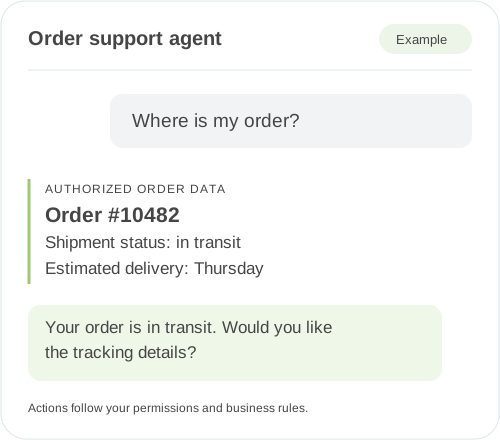
A customer asks: “Where is my order, and can I change the delivery address?”
Available actions depend on the connected systems, permissions, and business rules we configure.
Agentforce identifies the request and, where possible, the relevant order.
It retrieves order and shipment details the customer is authorized to access.
Configured business rules check whether the delivery address can still be changed.
The agent submits the permitted change, asking for confirmation or approval when needed.
The customer receives an update, or an employee takes over with the request history.


Give agents access to the information and actions each workflow needs. We connect Salesforce with ERP, commerce, and other applications while defining what agents may read, change, or pass to your team.
The integration approach follows your existing systems and requirements, with Data 360 or middleware added where the use case calls for it.
Give agents account, lead, and opportunity context for sales tasks.
Retrieve case history, update permitted records, and hand off complex requests.
Run approved workflows and custom actions with validation and error handling.
Retrieve authorized order, product, pricing, and availability data from SAP.
Bring customer and operational information from Dynamics into the agent’s workflow.
Connect order, shipment, and returns information for customer support.
Combine customer information when agents need context from several data sources.
Ground answers in approved knowledge articles, records, and business documents.
Connect external systems and expose only the data and actions an agent needs.
The selected projects include Agentforce customer service and supporting Salesforce, Data 360 and integration work. The quotation case uses Salesforce and Azure OpenAI; it is not an Agentforce implementation. Each case describes its own scope rather than a guaranteed result for another business.


A workflow you want to improve is a useful starting point. We review the people involved, the systems and data it uses, common exceptions, and what a successful result would look like before defining the scope.
A focused use case and an enterprise rollout have different delivery needs. We review system access, data quality, integrations, and approval requirements, then agree milestones for implementation and evaluation.
Yes. We review where agents give weak answers, fail to complete actions, or need too much human intervention, then prioritize improvements to the data, integrations, instructions, and testing.
Yes, through suitable APIs, middleware, or custom actions. We define the information an agent can retrieve and the operations it may initiate, including authentication, validation, approvals, and error handling.
It depends on the agent type and features you need. We check the technical and licensing requirements of your Salesforce org before deciding whether Salesforce records, configured actions, Data 360, or a combination is appropriate.
Yes, configured actions can update permitted records and run business logic through Flow, Apex, or APIs. We define which actions are allowed and where validation, confirmation, or human approval is needed.
We use approved data sources, restricted permissions, action validation, and clear escalation rules, then test representative requests and edge cases. Monitoring and review help identify issues after launch; AI responses still need appropriate controls.
We agree a baseline and track completed tasks, time saved, quality, human intervention, and running costs. Those results can then be compared with implementation, licensing, integration, and support costs to assess value.
Agentforce is Salesforce’s platform for building AI agents that retrieve information and carry out defined tasks for employees or customers. A useful implementation combines the agent with relevant data, configured actions, permissions, and testing.
A traditional chatbot usually follows predefined conversation paths. Agentforce can use business context to select configured actions, so it can support work beyond answering questions, within the access and rules defined for it.
Agreed scope covers use-case assessment, data preparation, agent configuration, actions, integrations, testing and handover. Responsibilities and acceptance criteria are defined before rollout.
Salesforce uses Agentforce 360 for its broader platform offering. Relevant capabilities depend on the workflow, edition, licenses and availability in your org. We check those prerequisites during planning.
Workflows, channels, data readiness, custom actions, integrations and testing determine the effort. Implementation, Salesforce licensing and usage, related data services and ongoing support are separate budget items.
A pilot evaluates a bounded use case with selected users and tests. A production rollout also needs agreed operating procedures, broader testing, monitoring and support. Milestones follow system access, dependencies and approvals.
The business owner defines the workflow and outcome. Salesforce and integration owners provide access and system context. Service or Sales Operations validate everyday scenarios; security and privacy stakeholders review the relevant controls.
Evaluate an implementation partner through comparable work, concrete deliverables and clear ownership of testing, handover and operation. Our case studies explain the technical scope and its limits.
The electronics-support Agentforce case covers knowledge retrieval and response preparation under technician control; time savings and resolution-rate improvements are unmeasured. The quotation case uses Salesforce and Azure OpenAI and does not demonstrate an Agentforce implementation.
The design defines execution context, data access and permitted actions. Tests cover missing information, failed actions and out-of-scope requests. Confirmation and human handoffs belong where the workflow requires them.
Review processing, retention and logging for the selected features, models and integrations. Monitoring complements explicit permissions and a named operating owner.
For product catalogs, pricing rules, quotes, contracts and billing, explore our Revenue Cloud implementation services. These revenue processes and their associated Agentforce capabilities need their own project scope.