
 Suomi
 Français
 Deutsch
 Polski
Moving from POS hardware to recurring revenue changed the operating model for a U.S.-based provider of point-of-sale and retail management solutions. Its customers increasingly wanted complete solutions combining terminals, scanners, payment devices, software subscriptions, installation, and support.
That shift created a more demanding commercial model. Routine Automation helped the company establish a connected revenue lifecycle through a governed Salesforce–SAP integration so that products, prices, orders, fulfillment, billing, and customer changes could work as parts of one process.
Client and industry
The client serves small and midsize retailers with POS hardware, retail software, inventory-management subscriptions, implementation assistance, training, and technical support. Its business model combines one-time purchases with recurring software and support revenue.
The sales organization had moved from HubSpot to Salesforce Sales Cloud, while SAP remained the enterprise resource planning platform. A basic catalog integration existed, but it did not connect the complete journey from commercial commitment through delivery, invoicing, and renewal.
Challenges and business impact

Disconnected order status
A closed opportunity did not confirm that SAP had accepted the order or that the solution had been delivered, limiting lifecycle visibility for Sales and Finance.
Mixed commercial models
Hardware, subscriptions, services, contract terms, and billing frequencies had to coexist in one transaction without losing the structure needed downstream.
Configuration and pricing risk
Dependent products, compatibility rules, variable prices, discounts, and margins relied on fragmented logic, increasing manual work and the chance of fulfillment exceptions.
Unclear system ownership
Product, price, cost, configuration, fulfillment, and billing data spanned Salesforce and SAP without sufficiently explicit ownership boundaries.
Revenue-recognition gaps
The business lacked a reliable connection among what was sold, delivered, and billed, weakening the information available for revenue-readiness decisions.
Fragmented customer changes
Amendments, upgrades, cancellations, and renewals were treated as disconnected sales instead of changes to an existing customer relationship.
What we implemented and why
We treated the engagement as a revenue-lifecycle program rather than an isolated quoting project. Salesforce Agentforce Revenue Management became the commercial layer on top of Sales Cloud, while the integration design kept operational and accounting responsibilities in SAP.
Implemented response | Design rationale |
|---|---|
Defined ownership for physical products, commercial products, prices, costs, configuration, orders, fulfillment, and billing. | One authoritative owner per data element reduces conflicting records and makes integration responsibilities explicit. |
Configured one-time and term-based selling models, bundles, attributes, compatibility rules, and quantity dependencies. | Hardware and subscriptions can be sold together without multiplying SKUs or allowing invalid combinations downstream. |
Established pricing procedures, SAP cost synchronization for margin visibility, and approval policies for commercial exceptions. | Calculated prices remain consistent while larger discounts and margin risks receive the appropriate review. |
Configured assets and subscriptions to support amendments, upgrades, cancellations, and renewals. | Teams can work from what the customer already owns instead of rebuilding each change as an unrelated sale. |
Connected order capture to SAP fulfillment and used Dynamic Revenue Orchestrator and Salesforce Field Service for delivery and installation coordination. | Each team can work in its appropriate system while Sales follows the complete fulfillment journey. |
Generated invoices in Salesforce from billing schedules and milestones, then passed invoice data to SAP for accounting. | Commercial billing can reflect each agreement while SAP remains responsible for accounting records. |
Implemented responses and the rationale for each design decision.
The design also connected commercial commitments with fulfillment and billing milestones. This did not replace the accounting process for revenue recognition; it gave Finance and business stakeholders a stronger basis for determining what had been sold, delivered, billed, and was ready for recognition.
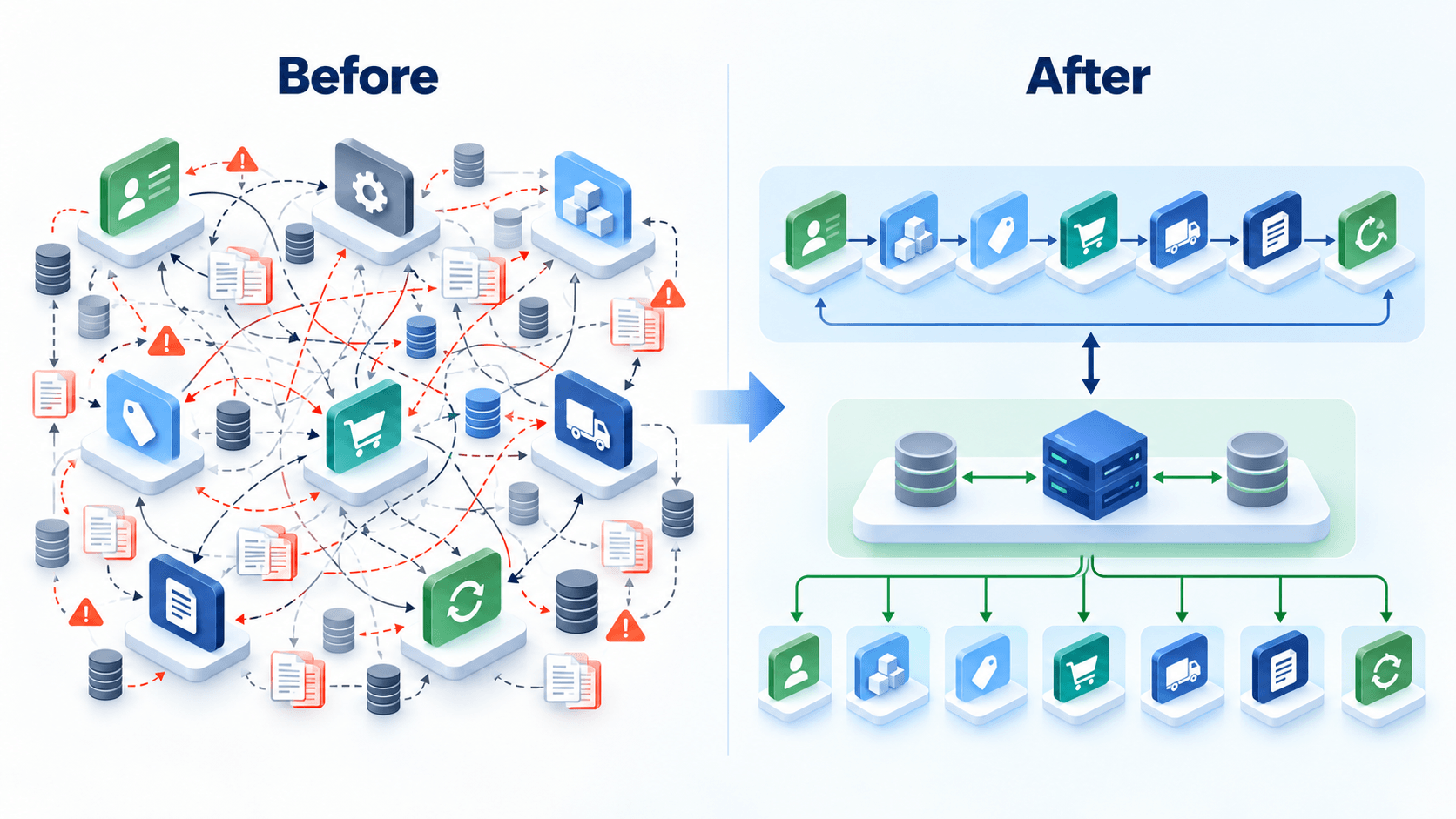
The engagement replaced disconnected handoffs with a governed lifecycle linking commercial activity, operational fulfillment, billing, and ongoing customer changes.
Benefits and problems addressed

Connected lifecycle visibility
Sales can follow a commercial commitment through order acceptance, shipment, installation, invoicing, and later customer changes.
Coherent hybrid selling
Hardware, software, support, and services retain their own terms while moving through one commercial process.
Governed configuration and pricing
Product rules, pricing procedures, cost visibility, and approvals create a more controlled path from configuration to fulfillment.
Clear system boundaries
Salesforce owns commercial packaging and selling logic, while SAP remains authoritative for physical product, cost, fulfillment, and accounting data.
Lifecycle-based customer management
Assets and subscriptions provide the context needed for amendments, upgrades, cancellations, and renewals.
Stronger finance handoffs
Fulfillment and billing milestones provide better-connected information for invoicing and revenue-readiness decisions.
Result
The client moved from a collection of disconnected sales and operational steps toward a shared revenue lifecycle for hardware and recurring services. The resulting architecture gives teams clearer ownership, preserves commercial intent downstream, and creates a foundation for managing the customer relationship beyond the initial sale.
The lasting value is not a single quoting feature, but a commercial architecture that connects how the company sells with how it fulfills, bills, and renews.