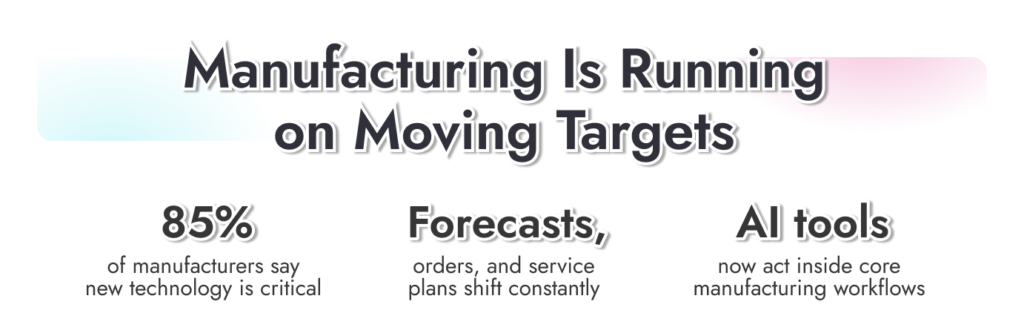
Manufacturing teams don’t really get a breather anymore. Forecasts move. Orders get tweaked halfway through. Service teams are stuck juggling equipment, parts, and customers who want updates right now. That’s why AI in manufacturing became part of the job.
Salesforce research backs that up. More than 85% of manufacturers now say new technology is critical if they want to stay competitive, especially with skills getting harder to find and manual work piling up faster than teams can clear it.
What’s changing is howAI in Salesforce shows up. Traditional dashboards and alerts help, but they still leave people doing the follow-up. Newer AI tools for manufacturing go further. They act. They adjust workflows. They support decisions in real time. This shift toward AI agents for manufacturing is where things start to feel different.
Salesforce’s response is Agentforce for manufacturing. It’s not another assistant offering suggestions that still leave work behind. It introduces AI agents in manufacturing that operate directly on forecasts, orders, assets, and service cases, helping teams move work forward instead of just talking about it.
Why Timing Breaks Manufacturing Operations
Manufacturing lives and dies by timing. When forecasts change late, when orders shift without warning, or when service teams walk in without the full picture, small slips turn into expensive problems. That’s where artificial intelligence in manufacturing earns its keep. It helps work keep moving when pressure builds.
Most manufacturers already use some form of manufacturing AI software. Forecast models, demand signals, quality checks. They’re familiar tools. They’re useful too. But they usually stop short of action. Someone still has to read the data, decide what matters, and push the next step through. That handoff is where momentum slows and problems start to stack up.
The bigger challenge is people. Industry research shows manufacturers are facing ongoing skills shortages while sales, service, and operations teams handle more volume each year. Adding headcount isn’t always possible. This is why interest in AI in manufacturing keeps growing. The goal isn’t to replace teams. It’s to reduce the routine work that pulls them away from real decisions.
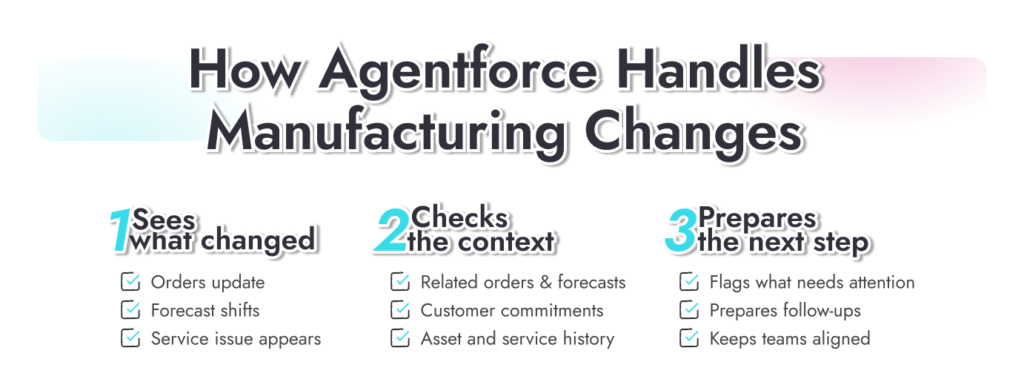
All of this explains the rise of AI agents in manufacturing. Unlike traditional tools, agents can react when conditions change. A forecast update can trigger a review. A delayed shipment can surface the right follow-up. A service spike can highlight capacity issues before schedules break. These actions are small, but they prevent larger problems later.
How Salesforce Applies AI in Manufacturing
Salesforce sits at the center of many manufacturing operations already. Sales teams manage accounts and forecasts there. Service teams track cases, warranties, and assets. Operations leaders rely on the same system to understand demand, commitments, and changes. What Salesforce has done over the last few years is bring AI in manufacturing directly into those everyday workflows, instead of keeping it separate in reports or analytics tools.
At a basic level, Salesforce connects customer data, products, contracts, forecasts, orders, and service records in one place. That foundation is what makes artificial intelligence in manufacturing useful. When data lives in silos, AI can only make guesses. When it’s connected, AI can respond with context.
This is where the platform has moved beyond insights. Salesforce AI can already predict demand shifts, flag risks, and surface trends. With Agentforce 3 AI agents in manufacturing, the next step is action. An agent can work across sales and service records, notice when something changes, and push the process forward without waiting for someone to intervene.
This approach turns AI tools for manufacturing into part of daily work. Instead of checking dashboards, teams get support inside the systems they already use. Salesforce positions Agentforce for manufacturing as that execution layer. It builds on existing Salesforce manufacturing solutions and applies AI where decisions and follow-ups actually happen.
Improve Field Service
Without Adding Headcount
See how Salesforce Field Service can help manufacturing teams respond faster, keep technicians informed, and reduce manual scheduling work when plans change.
Agentforce for manufacturing is Salesforce’s way of bringing AI into the parts of manufacturing work that usually struggle. Instead of another assistant that answers questions or summarizes records, it introduces AI agents for manufacturing that can work inside Salesforce and take approved actions when things change.
Agentforce runs on top of Salesforce’s manufacturing solutions. It uses the same data teams already rely on: forecasts, sales agreements, orders, assets, and service cases. The difference is what it does with that information. AI agents in manufacturing can monitor changes, connect related records, and move workflows forward without waiting for manual input.
Salesforce describes this as role-based digital work. Agents are set up around specific responsibilities, such as supporting forecast reviews, handling order exceptions, or helping service teams prepare for jobs. This is why Agentforce manufacturing features feel different from traditional automation. Rules follow fixed paths. Agents can pause, reassess, and act when conditions shift.
For manufacturers, the appeal is control. Teams decide what agents can do on their own and where people stay involved. Nothing runs in the dark. If you want a broader explanation of how this platform works across Salesforce, What is Agentforce in Salesforce covers the fundamentals.
Fundamentally, though, Salesforce Agentforce for manufacturing turns AI from analysis into execution, without forcing teams to change the systems they already use.
Plan Your Agentforce Rollout
Get practical guidance on setting up Agentforce for real manufacturing workflows, from data preparation to clear guardrails that keep teams in control.
Agentforce works best when it has context. Manufacturing is full of moving parts, and decisions rarely depend on a single record. Orders affect forecasts. Service issues affect delivery dates. Asset history shapes how support teams respond. Agentforce for manufacturers is designed to work across those connections, not inside one narrow workflow.
At its core, Agentforce relies on the same information manufacturing teams already manage in Salesforce. Forecasts, sales agreements, orders, inventory signals, service cases, warranties, and asset history all feed into the picture. When available, connected equipment data adds another layer. This context is what allows AI agents in manufacturing to respond in ways that make sense.
For example, a delayed shipment isn’t just a logistics issue. It can affect revenue timing, customer commitments, and service planning. An agent can see those links, surface the right follow-up, and prepare next steps instead of leaving teams to piece it together.
Agentforce vs Traditional Manufacturing Automation
Traditional automation follows strict rules. When something falls outside those rules, work stops and people step in. AI agents for manufacturing are built for the gaps. They can detect when conditions change, reassess what matters, and act within the limits you set.
This doesn’t remove control. It reduces repetition. Teams still define approvals, thresholds, and exceptions. The difference is that AI tools for manufacturing no longer wait for someone to notice a problem before anything happens.
Reduce Manual Work Across Manufacturing
We help you identify high-impact workflows and configure Agentforce, so AI agents handle the routine steps, while your teams stay focused on decisions that matter.
Most manufacturing teams struggle because too much work still sits between a signal and a response. Orders change, forecasts drift, service requests pile up, and someone has to chase each step by hand. This is where Agentforce for manufacturing makes such an impact.
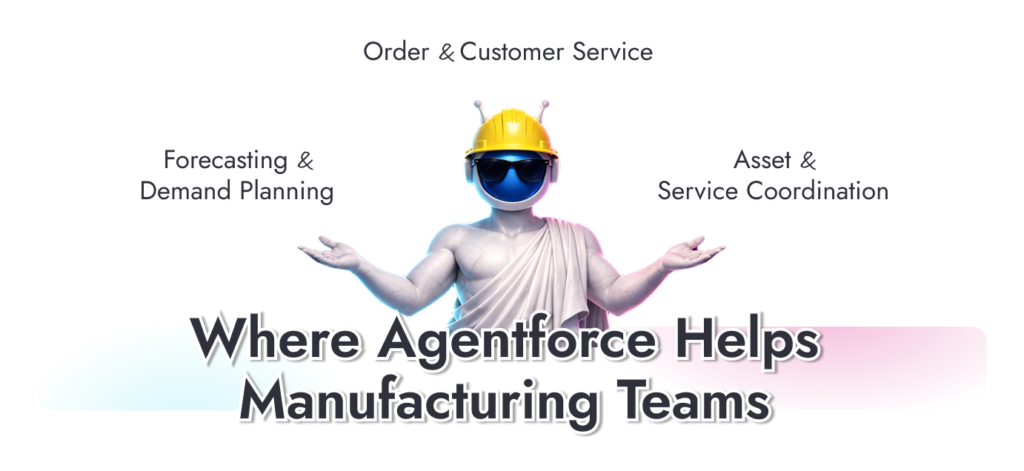
Sales Forecasting and Demand Planning Support
Forecasting is rarely the problem. Keeping forecasts aligned with reality is. Customers adjust volumes. Supply constraints appear late. Sales teams spot issues, but reacting takes time.
With AI in manufacturing, Agentforce can keep an eye on forecast changes as they happen. AI agents for manufacturing compare updated demand against open orders, agreements, and known constraints, then surface where plans no longer line up. Instead of digging through spreadsheets, teams see what needs attention first. Manufacturing AI software doesn’t replace judgement here. It reduces the effort it takes to apply it.
Customer Service and Order Management
Order-related questions never stop. Where is it? Can it be changed? Why is it late? Each one pulls time from service teams.
Using AI tools for manufacturing, Agentforce can support these moments by pulling live order data, spotting exceptions, and preparing responses before a case reaches an agent. When something falls outside normal rules, it’s routed with context instead of guesswork. This is how AI agents in manufacturing reduce workload without lowering service quality.
Asset and Service Coordination
Once products are in the field, coordination becomes harder. Service teams need history. Manufacturing teams need feedback. Missed details lead to repeat visits.
With Agentforce for manufacturing, agents bring asset records, past fixes, and open issues together before work starts. Service teams arrive prepared. Manufacturing gets cleaner signals from the field. Over time, Agentforce helps close the loop between production and service, without adding more admin work.
Real Examples of Agentforce in Manufacturing
Real manufacturing work is complicated. Plans change mid-week. Orders slip. Service teams work around missing parts and late information. This is where Agentforce for manufacturing tends to show the most value.
Here are a few common, real-world scenarios manufacturers focus on first:
Order exception handling: A supplier misses a delivery date. AI agents in manufacturing flag the affected orders, identify which customers are at risk, and prepare follow-up actions before the issue turns into a backlog of cases.
Faster service case triage: When a customer reports an equipment issue, AI tools for manufacturing pull asset history, warranty status, and recent service notes together. Service teams start with context instead of chasing background details.
Cleaner handoffs between service and manufacturing: Service outcomes and recurring issues are logged consistently. Manufacturing AI software helps surface patterns that feed back into planning, quality, and product teams.
Proactive customer communication: When plans change, agents can help pull together accurate updates from live data. Fewer follow-up emails. Fewer “just checking in” calls. Customers stay informed without someone chasing every detail.
Reduced repeat work: Better prep and records mean fewer second visits, fewer internal clarifications, and less time spent fixing the same issue twice.
These examples show how Salesforce Agentforce for manufacturing supports daily operations. The goal isn’t automation for its own sake. It’s removing routine friction so teams can respond faster when something changes.
The Business Value of Agentforce for Manufacturing Companies
The impact of Agentforce for manufacturing is easiest to see in day-to-day outcomes. Not in abstract metrics, but in how work moves through sales, operations, and service with fewer delays and fewer manual fixes.
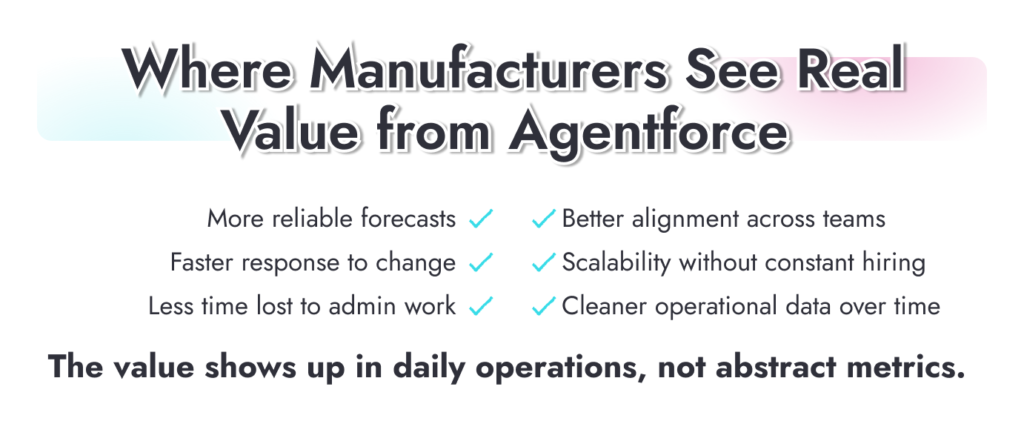
Key areas where manufacturers see value include:
More reliable forecasts: With AI in manufacturing, teams spend less time reconciling numbers and more time responding to real changes. Forecast updates are flagged early, before they affect commitments or production plans.
Faster response to change: When orders shift or service demand spikes, AI agents in manufacturing help surface the right actions quickly. Fewer issues sit unnoticed in queues.
Less time lost to admin work: Status checks, record updates, and routine follow-ups take less effort. AI tools for manufacturing handle the background work that usually eats into the day.
Better alignment across teams: Sales, service, and operations work from the same context. Manufacturing AI software reduces gaps caused by handoffs and missing information.
Scalability without constant hiring: As volume grows, Agentforce for manufacturers helps teams handle more work without adding the same amount of headcount.
Cleaner operational data over time: More consistent updates and summaries improve reporting and long-term planning, especially for service and asset management.
For many organizations, Salesforce Agentforce for manufacturing isn’t about chasing efficiency targets. It’s about keeping operations stable as complexity increases, without burning out the people who keep things running.
When Agentforce Makes Sense for Manufacturing Teams
Agentforce isn’t just something you switch on just because it’s available. It works best in specific situations, usually where teams already feel strain and small issues keep piling up. Agentforce for manufacturing tends to deliver value when there is enough structure to support it, but enough complexity that manual work slows things down.
Manufacturers usually feel the biggest impact in a few familiar situations:
High volume of changes: Orders get updated. Forecasts shift. Service requests come in late. Follow-ups stack up fast. AI agents in manufacturing help catch those changes early and send them where they belong, before the backlog starts to grow.
Teams stretched thin: When sales, service, or operations teams spend large parts of the day checking status or updating records, AI in manufacturing helps reduce that background load.
Connected but underused data: Many manufacturers already have forecasts, orders, assets, and cases in Salesforce. Manufacturing AI software works best when that data is available but not fully acted on.
Clear rules and ownership: Agentforce needs boundaries. Teams that know what can be handled automatically, and what needs review, get more value from AI tools for manufacturing.
There are also cases where it makes less sense. If data is unreliable, processes change daily, or ownership is unclear, agents will surface problems faster than they solve them. In those situations, preparation comes first.
How Routine Automation Supports Agentforce for Manufacturing
Agentforce works best when it’s shaped around real manufacturing work, which is why a lot of companies struggle with figuring out how to implement Agentforce in Salesforce. They need support from people with the right experience, who can ensure their setup works with clean data, clear rules, and workflows that reflect how teams actually operate.
Routine Automation starts by looking at how sales, service, and operations work today. Not diagrams. The real flow. Where forecasts break. Where orders get stuck. Where service teams lose time. This helps identify where AI agents in manufacturing can remove friction without creating new risk.
Support typically focuses on a few practical areas:
Manufacturing process assessment in Salesforce: Reviewing forecast management, order handling, service cases, and asset records to find high-impact starting points for AI tools for manufacturing.
Data and architecture preparation: Making sure product, customer, asset, and order data is reliable and connected, so manufacturing AI software has something solid to work with.
Agentforce configuration based on real scenarios: Agents are set up around specific tasks, with clear limits. Nothing runs without oversight. This is where Agentforce for manufacturers becomes useful instead of disruptive.
Ongoing support and optimization: As volumes change, agents are adjusted. New use cases are added carefully. The goal is steady improvement, not a one-time rollout.
If you’re planning next steps, Routine Automation can walk you through a structured rollout.
Build Agentforce Around Your Operation
Work with specialists who understand manufacturing workflows and Salesforce, so AI agents support real work instead of adding complexity.
Manufacturing teams need fewer loose ends. Orders change, forecasts move, service issues stack up, and someone always ends up stitching the process back together by hand. That’s the issue Agentforce for manufacturing is meant to address.
By bringing AI agents in manufacturing directly into Salesforce, Agentforce shifts AI from observation to execution. Forecast updates trigger follow-ups. Order issues surface early. Service teams start with context instead of questions. The work still belongs to people, but less of it gets stuck waiting.
For manufacturers already using Salesforce, this approach builds on what’s there. AI in manufacturing becomes part of daily operations, not a side system. When implemented carefully, Salesforce Agentforce for manufacturing helps teams stay responsive as complexity grows, without relying on workarounds or burnout to keep things moving.
FAQs
Agentforce for Manufacturing is Salesforce’s approach to using AI agents inside manufacturing workflows. These agents work with forecasts, orders, assets, and service data to support and automate routine actions while keeping teams in control.
It reduces manual follow-ups, status checks, and data gathering. AI tools for manufacturing handle repeat work so teams can focus on exceptions and decisions.
Common areas include forecasting support, order exception handling, customer service, asset and service coordination, and post-sale support.
Manufacturers with frequent order changes, complex service operations, or teams stretched thin tend to see the strongest impact from Agentforce manufacturing features.
Routine Automation supports assessment, data preparation, agent configuration, and ongoing optimization, helping teams use manufacturing AI software in a controlled, practical way.
Talk Through Your Salesforce AI Options
If you’re considering Agentforce or other Salesforce AI tools for manufacturing, we can help you assess readiness, map real use cases, and plan a rollout that fits how your teams actually work.
Your vision, our experts - adaptable teams for every need.
Support at any stage
Always there for you - support through every phase.
Among Our Clients:
×
Thank you for your message!
Look out for our quick follow-up!
×
Nearly done!
It looks like some fields need to be reviewed and corrected. Please fix the highlighted errors and resubmit.
Should Salesforce be your next big move?
By clicking “Accept All Cookies”, you allow us to use cookies on your device to improve site navigation, track site usage, and support our marketing strategies. Learn more in our Cookie Policy & Personal Data Policy