

 Suomi
 Français
 Deutsch
 Polski
Client and industry
A European manufacturer and distributor supplies products through retail partners, e-commerce platforms and its own digital sales channels. Product, inventory and availability information must move reliably between its operational systems and external partners.
Microsoft Dynamics 365 manages operational inventory data. As the distribution network grew, the customer needed a reusable integration foundation so each new destination would not require the same ERP data preparation to be built again.
Challenges and business impact

More partners, more integration logic
Each retailer introduced new data exchange requirements. Dedicated ERP-to-retailer connections would increase maintenance complexity as the partner network expanded.

Repeated data preparation
Similar product and inventory transformations risked being rebuilt for each destination, adding development effort and spreading shared business rules across separate integrations.

Limited reuse beyond the ERP
Operational information remained primarily within the ERP environment. Data prepared for one integration was not necessarily available to other applications, limiting the foundation for future channels and digital services.
What we implemented and why
Routine Automation introduced Salesforce Data 360 as an ingestion and transformation layer between the operational environment and downstream consumers. The initial requirement was sharing inventory availability with external retail partners; the design also allowed shared preparation to be reused.
Architecture overview
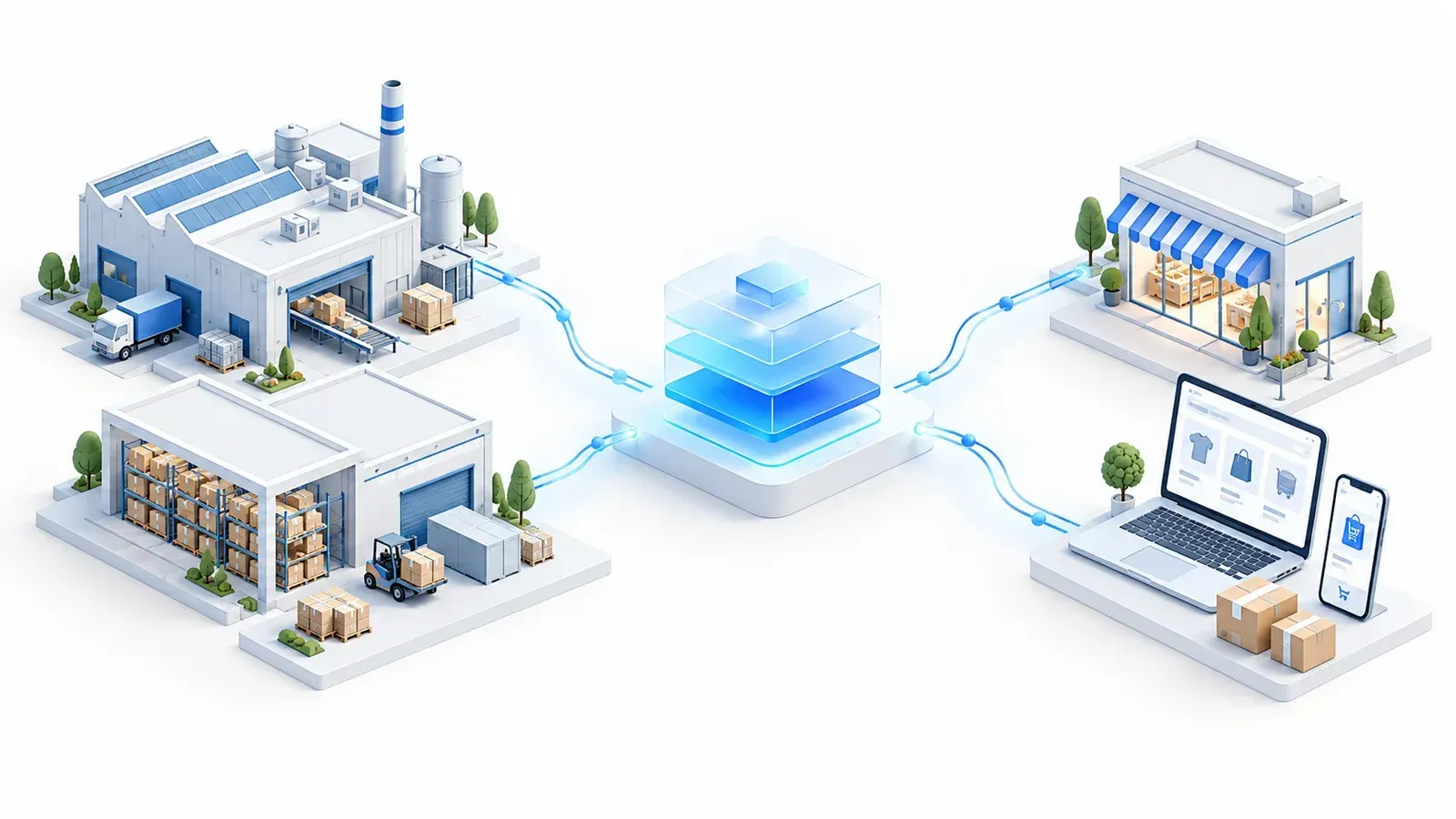
Product and inventory information originating in Dynamics 365 was made available through Azure Blob Storage, ingested into Salesforce Data 360 and processed with Data Transforms for downstream consumption.
Microsoft Dynamics 365
Operational product and inventory information. The ERP remains authoritative for warehouse inventory.
Azure Blob Storage
Makes source datasets available for ingestion into Salesforce Data 360.
Salesforce Data 360
Ingests datasets. Data Transforms process and combine product and inventory information into reusable structures.
External consumers
Prepared availability outputs support retail integrations. Each destination may require its own mapping and delivery mechanism.


Implementation decisions
Establish a consistent ingestion path
Ingest product and inventory datasets through Azure Blob Storage so downstream integrations do not each need to retrieve and prepare the same ERP information independently.
Share transformation logic
Use Data Transforms to process and combine the datasets centrally. Consumers can reuse this preparation while retaining destination-specific mappings, authentication and delivery requirements.
Preserve operational ownership
Keep warehouse inventory ownership in Dynamics 365. Data 360 handles ingestion and preparation, separating operational responsibilities from downstream consumption.
Business value

A reusable starting point for new channels
Additional retail partners can build on the existing ingestion and transformation foundation. The common ERP preparation does not necessarily need to be recreated for every destination.
Shared logic with a clearer maintenance boundary
Common transformations sit in a shared processing layer. Source changes and shared business rules can be addressed centrally for consumers that use that layer, rather than maintained separately in every integration.
Data prepared for broader reuse
The foundation makes product and inventory information reusable beyond the initial inventory-sharing requirement, providing a basis for additional channels and internal digital services.
Future opportunities
The architecture creates opportunities for partner portals, internal applications, analytics and AI assistants that use product and inventory information. These are potential extensions, not functionality delivered as part of the initial project.
Result
Routine Automation established a Data 360 integration architecture for preparing manufacturing product and inventory information for external retail channels. By separating ERP ownership from shared ingestion, transformation and downstream consumption, the customer gained a foundation for additional integrations without each new use case starting with independent ERP data preparation.