Simplify Complex Integrations
Cut manual effort, reduce errors, and speed up system-to-system workflows. Discover how Routine Automation builds MuleSoft solutions that keep operations running smoothly at scale.



A major fuel company in Poland was sitting at the center of everyday mobility. They provide fuel cards, payment solutions, and corporate services that keep fleets moving and employees on the road. With thousands of transactions running through their systems each day, smooth operations weren’t just nice to have, they were the heart of the business itself.
The problem was what happened behind the curtain. Salesforce for energy and utilities handled customer data and processes, but other core systems, each critical in its own right, were running in isolation. Passing information between them required fragile workarounds and manual fixes. Every extra step introduced risk.

The leadership team knew they needed more than another patch. They needed a stable integration layer that would connect four systems, handle complex file formats, and keep data flowing reliably without constant babysitting. That’s when they turned to Routine Automation.
The company’s daily operations depended on information moving between four platforms, including Salesforce. But the integrations in place weren’t up to the task.
Multi-step processes slowed things down. Every time a transaction had to cross from one system to another, it meant extra handling. The variety of EDI files only added to the mess. Each one came through in its own format, and none of them matched. Getting them parsed took far more time than it should. When a file didn’t transfer cleanly, the team had to step in by hand, slowing everything down and opening the door for mistakes.
In an industry where thousands of files and transactions move every day, those cracks add up fast. A small delay in processing isn’t just an internal inconvenience; it can ripple outward to customers who expect fuel services and payments to run on time, every time. The stakes were too high for fragile fixes.
For the RA integration team, the technical challenge was clear:
The business goal was even clearer: build a stable, automated framework that gave the company confidence its systems would run at scale without slowing down.
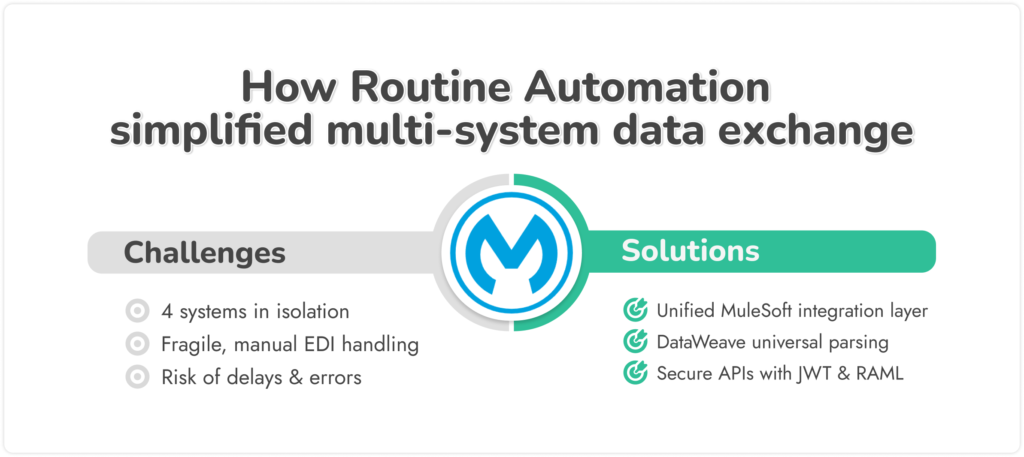
Routine Automation’s role wasn’t just to connect a few systems. The challenge was to design an integration framework that could handle heavy data loads, multiple formats, and the security requirements of a major energy provider. MuleSoft became the backbone of that solution.
At the heart of the project was the framework itself. This wasn’t about wiring a few systems together and calling it done. The company needed something strong enough to carry heavy volumes of data every day, flexible enough to deal with different formats, and secure enough for an energy provider handling sensitive transactions.
MuleSoft and Salesforce became the backbone. Routine Automation’s team built APIs that could move information between Salesforce and the other core systems without breaking down under load. DataWeave handled the transformations in the middle, shaping files so that when they landed, they were in the right format for the next system in line.
Security was built in from the start. JWT and RAML standards were applied to make sure exchanges were locked down but still flexible enough to adapt as requirements changed.
The outcome wasn’t just data moving faster. It was data moving in a way the client could trust: accurate, consistent, and secure every time it crossed from one system to another.

See how MuleSoft APIs and Salesforce work together to simplify integrations, improve data quality, and keep systems in sync.
One of the toughest parts of the job was the files themselves. Every system produced EDI files, but none of them looked the same. Some had extra fields, some were missing values, some followed their own conventions entirely. The old way of dealing with it meant writing custom fixes for each variation. It worked, but it was fragile, and every new file type added another layer of complexity.
The RA team wanted something cleaner. They built a common approach in DataWeave that could read different formats without needing a fresh block of code each time. A properties file sat alongside it, so shared rules didn’t have to be rewritten again and again. That shift meant the company didn’t need to worry about adding new formats later, the groundwork was already there.
It wasn’t the kind of change customers would ever notice directly, but for the people managing integrations every day, it was the difference between firefighting and getting ahead of the work.
This project was small in numbers but heavy in complexity. Just two Routine Automation specialists were on the RA side, paired with the client’s own IT team. That tight setup turned out to be a strength, decisions were made quickly, testing happened in real time, and both sides could course-correct when priorities shifted.
The work stretched over seven months. In that time, the scope covered everything from consulting and planning to hands-on integration, testing, deployment, and finally training. Instead of handing over a finished product and walking away, RA made sure the client’s team was comfortable running the system themselves.
By the end, the integration framework wasn’t just a piece of software. It was a shared effort, something both teams had shaped and understood. That trust mattered as much as the technical outcome, the client knew exactly how the system worked and why it could be relied on.
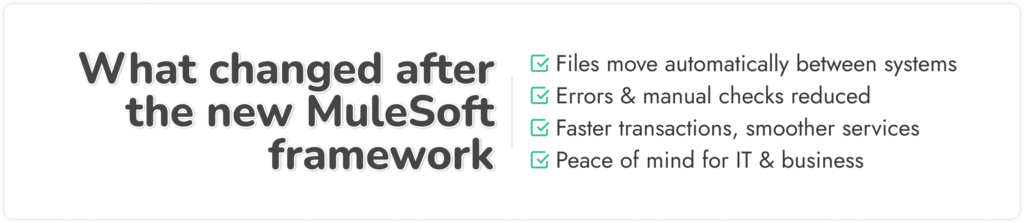
Once the new integration layer went live, the difference was easy to see. Files that used to need manual checks were moving between systems on their own. Data flowed from Salesforce to the other platforms and back again without stalling. What had been a tangle of steps became a single, steady process.
For the IT staff, it meant fewer late nights chasing down mismatched records or writing throwaway scripts just to get a file through. The universal parsing method handled new formats without drama, so the team could spend time on real improvements instead of patchwork fixes.
On the business side, transactions sped up and errors dropped away. Managers had more confidence in the numbers they were seeing. Customers didn’t know about the technology behind it, but they noticed the outcome: services ran smoother, and requests were handled faster.
The company didn’t need a dashboard of KPIs to prove the point. In an industry that processes thousands of transactions every day, cutting out delays and mistakes is value in itself. The real gain was peace of mind – knowing the systems were working in the background, quietly keeping the business moving.