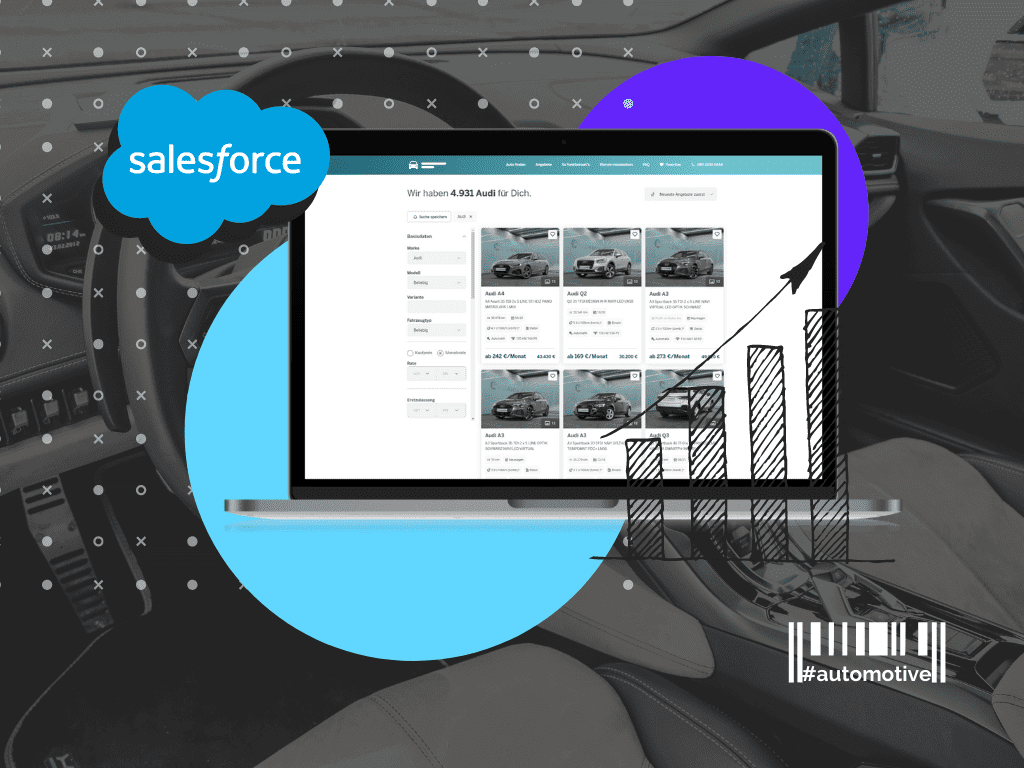
Wie Salesforce die Automobilindustrie verändert

  • A shorter, smoother path from lead to sale
  • Far better visibility into service workflows and appointment volumes
  • Stronger, more consistent collaboration across every dealer touchpoint

Salesforce-Funktionen für die Automobilindustrie

Automatisieren Sie den Kundensupport

Wenn Kunden sich melden, erwarten sie schnelle Antworten, keine mühsame Suche nach Informationen in unzusammenhängenden Tools. Cloud-Dienst Mit Salesforce Automotive CRM für Teams in der Automobilindustrie haben Supportmitarbeiter alle Datensätze an einem Ort. Fälle werden automatisch an den richtigen Berater weitergeleitet, Garantiedetails sind sofort verfügbar und Chatbots beantworten einfache Fragen, ohne die Mitarbeiter zu behindern. Diese Lösung verkürzt Reaktionszeiten und sorgt für positive Kundenzufriedenheitswerte.

Optimierung der Außendiensttätigkeiten

Die meisten Serviceverzögerungen beginnen mit einfachen Abstimmungsproblemen: Ein Techniker hat aktualisierte Anweisungen verpasst, Teile werden nicht schnell genug erfasst oder Zeitpläne verschieben sich unbemerkt. Salesforce für Marken der Automobilindustrie mit Service Monteure Diese Reibungsverluste werden reduziert, indem Teams einen zentralen Überblick über den aktuellen Status erhalten. Techniker erhalten übersichtliche Arbeitsaufträge und Teileinformationen auf ihren Smartphones, während Disponenten die Arbeitsbelastung ohne Rätselraten anpassen können.

Optimierung der Händlerzusammenarbeit

OEMs und Händlergruppen arbeiten oft mit unterschiedlichen Systemen und Annahmen, was den gesamten Prozess verlangsamt. Sales Cloud Dank Salesforce für die Automobilbranche haben alle Zugriff auf dieselben Verkaufsdaten, Programmdetails, Lagerbestände und Lead-Zuordnungen. Nichts geht in E-Mails verloren. Nichts wartet mehr darauf, dass „jemand das Update schickt“. Händler erhalten klarere Anweisungen, und OEMs sehen endlich, was wirklich vor Ort passiert.

Integrations-Workflows vereinfachen

Automobilunternehmen sind in der Regel auf eine Vielzahl von Systemen angewiesen. Dazu gehören DMS-Plattformen, ERP-Systeme, Finanztools, Telematik-Datenfeeds und vieles mehr. Dienstleistungen, die diese Systeme unterstützen, sind ebenfalls verfügbar. Salesforce-Integration für die Automobilindustrie Setups helfen dabei, all dies in einen einzigen Workflow zu integrieren. Informationen gehen nicht mehr in separaten Datenbanken verloren, Aktualisierungen erfolgen zuverlässiger und Teams müssen Daten nicht mehr mehrfach eingeben. Ob DMS-Anbindung, Fahrzeugdatenstrom oder Teileinventar-Tool – diese Integrationen sorgen für einen reibungslosen Ablauf im gesamten Betrieb.

Starke datengestützte Entscheidungen

Das Bauchgefühl ist hilfreich, aber es ersetzt kein übersichtliches Dashboard. Tableau Salesforce Analytics bietet OEMs und Händlern einen umfassenden Überblick über Vertriebsleistung, Servicevolumen, Effektivität von Anreizsystemen und Kundenverhalten. Schluss mit dem Rätselraten, warum eine Region hinterherhinkt oder welche Servicepakete die Kundenbindung fördern – die Antworten finden sich in Echtzeit-Dashboards, die für jeden zugänglich sind, nicht nur für das Datenteam.

Erzielen Sie Ergebnisse durch individuelle Anpassung

Standardlösungen passen selten zu den tatsächlichen Arbeitsabläufen von Teams in der Automobilbranche. Deshalb ist die individuelle Anpassung so wichtig. Von Angebotsvorlagen über Preislogik bis hin zu Händlerportalen – Salesforce lässt sich an Ihre realen Prozesse anpassen. Vielleicht benötigen Sie benutzerdefinierte CPQ-Abläufe für Zubehör oder ein Reparaturauftragsmodul, das mit dem Lagerbestand verknüpft ist. Was auch immer Ihr Bedarf ist, Salesforce-Lösungen für die Automobilindustrie Passen Sie sich an, ohne Ihre Arbeitsabläufe zu unterbrechen.

Salesforce Automotive Cloud Overview

Salesforce Automotive Cloud is Salesforce’s industry-specific platform built for OEMs, dealer groups, and automotive retailers that need their data, service processes, and customer touchpoints connected instead of scattered. It gives teams a single view of vehicles and customers, powered by automation and AI. Routine Automation helps companies implement, customize, and integrate Salesforce auto cloud to fit real operational needs.

Unlock the Power of Salesforce Automotive Cloud

Highlight 5 practical advantages or use cases of Salesforce Automotive Cloud.

360°-Kundenansicht
360°-Kundenansicht

Automotive Cloud pulls customer, vehicle, and service data into one place so teams don’t have to hunt for information or rely on half-finished records. Everyone works from the same picture, not five versions of it.

OEM–Dealer Collaboration

Program updates, incentives, inventory changes: they move faster when OEMs and dealers share one platform. It cuts down on the quiet gaps that slow decisions or leave stores out of sync.

Service-Lebenszyklus-Management

Every service visit, repair order, and warranty event sits in a single timeline. Advisors see what happened last time, what’s pending, and what needs attention now, which makes conversations with customers far easier.

Vorausschauende Einblicke

Salesforce in Automotive uses built-in AI to flag things early: customers likely to return, vehicles due for work, or leads showing buying signals. It’s just useful information that helps teams act sooner.

Built-in Industry Compliance

Reporting and communication rules can get messy across large dealer groups. Automotive Cloud keeps the required data in one place and reduces the manual tracking that usually causes trouble later.

360°-Kundenansicht
360°-Kundenansicht

Automotive Cloud pulls customer, vehicle, and service data into one place so teams don’t have to hunt for information or rely on half-finished records. Everyone works from the same picture, not five versions of it.

OEM–Dealer Collaboration

Program updates, incentives, inventory changes: they move faster when OEMs and dealers share one platform. It cuts down on the quiet gaps that slow decisions or leave stores out of sync.

Service-Lebenszyklus-Management

Every service visit, repair order, and warranty event sits in a single timeline. Advisors see what happened last time, what’s pending, and what needs attention now, which makes conversations with customers far easier.

Vorausschauende Einblicke

Salesforce in Automotive uses built-in AI to flag things early: customers likely to return, vehicles due for work, or leads showing buying signals. It’s just useful information that helps teams act sooner.

Built-in Industry Compliance

Reporting and communication rules can get messy across large dealer groups. Automotive Cloud keeps the required data in one place and reduces the manual tracking that usually causes trouble later.

See What Automotive Cloud Can Do for Your Business

Partnerbild

Common Automotive Pain Points We Help Solve

OEM and dealer systems that don’t line up:

Updates don’t land at the same time, people work from different numbers, and decisions end up based on whatever data someone could find that morning.

Claims and service requests still handled manually:

A few emails, a spreadsheet and someone promising to watch for updates often end up deciding how quickly a claim moves. Small delays slip through without anyone meaning for it to happen.

Sales performance only visible after it is too late:

Managers get the numbers at the end of the week or month, which makes it harder to spot problems early or adjust before momentum is lost.

Customer information scattered across several places:

Parts of a customer’s history live in different systems, so teams only see fragments when they’re trying to help or follow up.

Service workflows with unclear status:

It’s not obvious which repair orders are waiting, which ones are held up, or whether a technician needs support. Small delays add up quickly.

Lead follow-ups slipping:

Some leads come in fast, others quietly pile up, and a few never reach the right person. High-intent buyers end up waiting without meaning to.

OEM and dealer systems that don’t line up:

Updates don’t land at the same time, people work from different numbers, and decisions end up based on whatever data someone could find that morning.

Claims and service requests still handled manually:

A few emails, a spreadsheet and someone promising to watch for updates often end up deciding how quickly a claim moves. Small delays slip through without anyone meaning for it to happen.

Sales performance only visible after it is too late:

Managers get the numbers at the end of the week or month, which makes it harder to spot problems early or adjust before momentum is lost.

Customer information scattered across several places:

Parts of a customer’s history live in different systems, so teams only see fragments when they’re trying to help or follow up.

Service workflows with unclear status:

It’s not obvious which repair orders are waiting, which ones are held up, or whether a technician needs support. Small delays add up quickly.

Lead follow-ups slipping:

Some leads come in fast, others quietly pile up, and a few never reach the right person. High-intent buyers end up waiting without meaning to.

Vorteile für Automotive

Salesforce für Autohäuser und Automobilunternehmen bietet:

Vorteile für Automotive
Vorteile
Schnellere Verkaufsbewegung
Vorteile
Mehr Stammkunden
Vorteile
Reduzierung des alltäglichen Abfalls
Vorteile
Klarere, frühere Erkenntnisse

See What Streamlined Automotive Operations Can Do for You

Partnerbild

Why Automotive Companies Trust Routine Automation

Automotive teams usually come to us when their systems feel too scattered or too rigid to support the way they actually work. Our job is to fix that without adding extra complexity. We’ve spent years working with Salesforce across different industries, including automotive, so we know how to translate real operational needs into a setup that teams can rely on every day. Certifications matter, but understanding how dealerships, OEMs, and service teams function in practice matters just as much, and that’s where we focus.

5+
years working with Salesforce for car dealers and automotive brands
4.9/5
client satisfaction score on the Salesforce AppExchange
50+
certified experts covering implementation, customization, and integrations

Gemeinsam zum Erfolg

Reihe Reihe Reihe Reihe Reihe Reihe Reihe Reihe Reihe Reihe Reihe Reihe Reihe Reihe Reihe Reihe Reihe Reihe Reihe Reihe Reihe Reihe
Gemeinsam zum Erfolg
Reihe
Reihe
Reihe
Reihe
Reihe
Reihe
Reihe
Reihe
Reihe
Reihe
Reihe
Reihe
Reihe
Reihe
Reihe
Reihe
Reihe
Reihe
Reihe
Reihe
Reihe
Reihe

Our Salesforce Implementation Roadmap

Entwurf & Ausarbeitung
We map out how your sales, service, and dealer processes should work inside Salesforce, so the system supports what your teams already do well.
Step-1
Implement & Configure
Workflows, data structures, and integrations are set up around your actual operations, not generic templates.
Step-2
Testen und validieren
Real scenarios are run through the system to confirm everything works cleanly before anyone relies on it.
Step-3
Deploy & Train
Your teams get hands-on guidance throughout. That’s how we make Salesforce implementation for automotive industry companies feel seamless.
Step-4
Evolve & Improve
As your business shifts, and the Salesforce automotive cloud evolves, we adjust processes and dashboards to keep things aligned.
Step-5
Support & Maintain
We stay involved after launch to handle updates, questions, and new requests as they come up.
Step-6

Ready for a Salesforce Setup That Fits How You Actually Work?

Partnerbild

Gemeinsam zum Erfolg

Reihe Reihe Reihe Reihe Reihe Reihe Reihe Reihe Reihe Reihe Reihe Reihe Reihe Reihe Reihe Reihe Reihe Reihe Reihe Reihe Reihe Reihe
Gemeinsam zum Erfolg
Reihe
Reihe
Reihe
Reihe
Reihe
Reihe
Reihe
Reihe
Reihe
Reihe
Reihe
Reihe
Reihe
Reihe
Reihe
Reihe
Reihe
Reihe
Reihe
Reihe
Reihe
Reihe

Unsere echten Geschichten, Ihre echten Ergebnisse

FAQ: Salesforce für die Automobilindustrie

Wenn Sie noch Fragen haben, öffnen Sie bitte eine davon.
Wir haben Antworten:

Was ist Salesforce für die Automobilbranche?

It’s basically Salesforce adjusted for how automotive teams actually operate. Not a different product, more of a focused setup that helps dealers, OEMs, and service departments work from the same customer and vehicle info instead of chasing it across tools.

Wie lange dauert die Salesforce-Implementierung für die Automobilbranche?

Hard to give one number. Some groups only need a few pieces set up, and that goes quickly. Others have older systems or several stores, which naturally takes longer. We look at how everything works today, then give a timeline that fits your situation.

Wie viel kostet die Implementierung von Salesforce für die Automobilindustrie?

Pricing shifts a lot depending on how much you want the system to do. A light setup costs less; anything involving integrations or custom processes pushes it up. We do a short review, figure out what you actually need, and then give a real number.

Kann ich Salesforce selbst intern implementieren?

Some teams give it a shot, especially if they already have someone who’s touched Salesforce before. The tricky part is that automotive setups have all these little pieces: warranty rules, lead routing, service workflows, that don’t always behave the way you expect once everything goes live.

Welche Vorteile bietet die Zusammenarbeit mit einem Salesforce-Partner?

A partner brings outside perspective, which helps a lot. They’ve seen what tends to break, what usually gets overlooked, and the setups that hold up once a whole dealer group starts using the system. Instead of trial-and-error, you get guidance, cleaner structure, and support when something needs to change. It generally prevents the “we have to redo this” moment six months in.